
ContrastNest is reader-supported. When you buy through links on this page we may earn a commission, at no extra cost to you. Our guides are research-based and AI-assisted, and checked against sources; we don’t claim hands-on testing. Affiliate Disclosure →
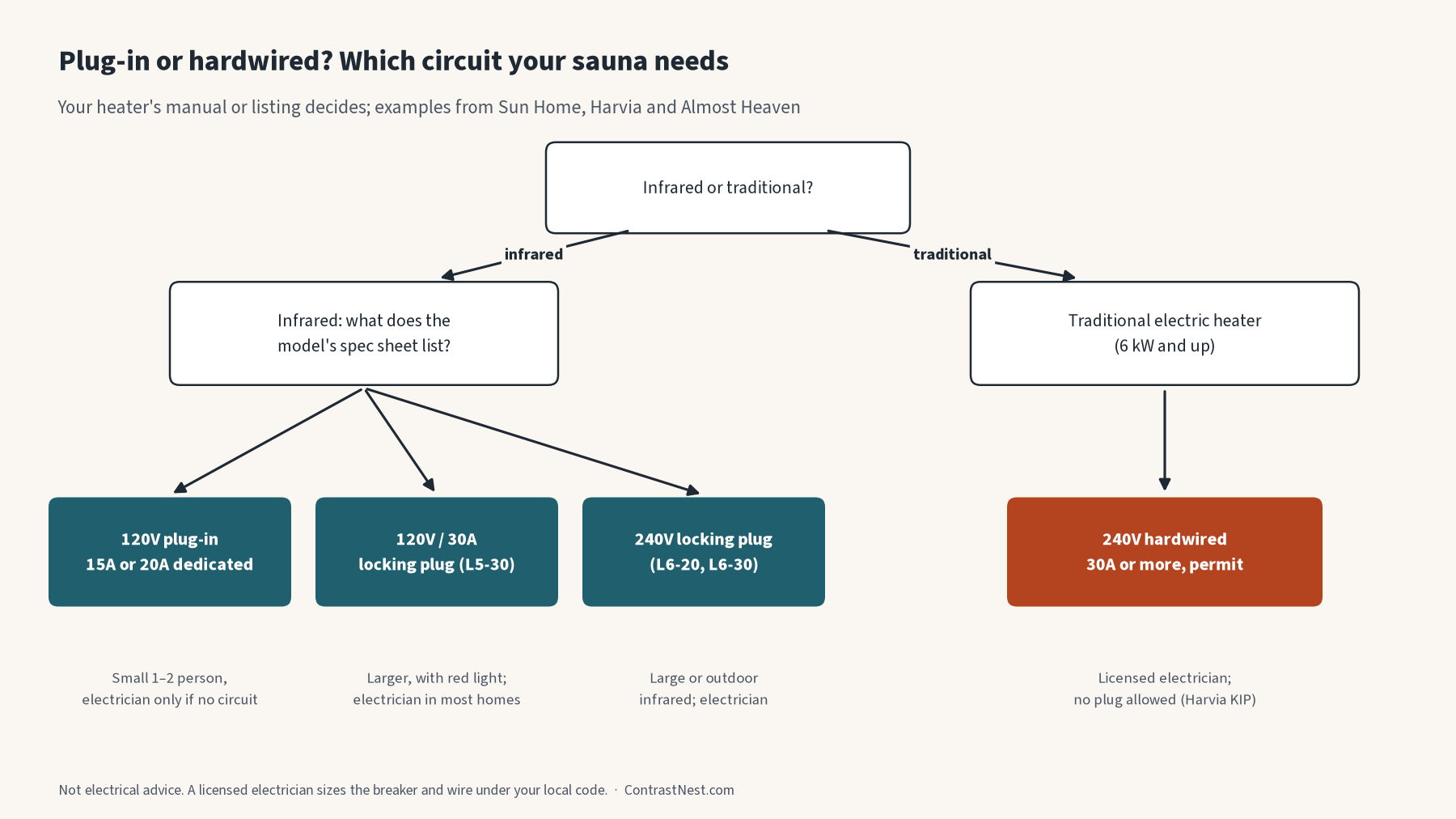
The short answer: No, not every sauna needs 240V. Many infrared cabins run on 120V, but almost all of them still want a dedicated circuit, and some need a 20A or 30A circuit most homes don’t already have. Traditional electric heaters in the common 6 kW size are 240V and hardwired, which means a licensed electrician, a new breaker and usually a permit. Your heater’s manual or listing sets the breaker and wire size, not a rule of thumb.
How we researched this: This guide is research-based. We have not tested, installed, wired or metered any sauna or heater mentioned. We compiled it from manufacturer manuals and spec pages, code summaries, NFPA’s adoption data, published cost guides, local permit offices and cited owner reports, all checked on November 1, 2026, with prices, code citations and links re-checked on November 3, 2026.
Not electrical or legal advice. This page explains what to ask for; it is not wiring instructions. Have a licensed electrician do the work and pull the permit, and follow your heater’s manual and the code your city or state has adopted.
Quick answer: which saunas need 240V
| Sauna type | Typical supply | Plug or hardwire? | Electrician likely? |
|---|---|---|---|
| Small 120V infrared (1–2 person) | Dedicated 120V, 15A or 20A | Plug-in | Only if no suitable dedicated circuit exists |
| Larger 120V infrared with red light | Dedicated 120V/30A | Locking plug | Yes, in most homes |
| Large or outdoor infrared | Dedicated 240V, 20A or 30A | Locking plug | Yes |
| Traditional electric heater (6 kW and up) | Dedicated 240V, 30A or more | Hardwired | Yes, plus a permit in most places |
120V vs 240V saunas: model table
| Model | Voltage | Load (maker) | Circuit and plug (maker) |
|---|---|---|---|
| Dynamic Barcelona (far IR, 1–2 person) | 120V | Wattage not published on the pages we checked | 15A, dedicated outlet recommended, non-GFCI (dealer listing) |
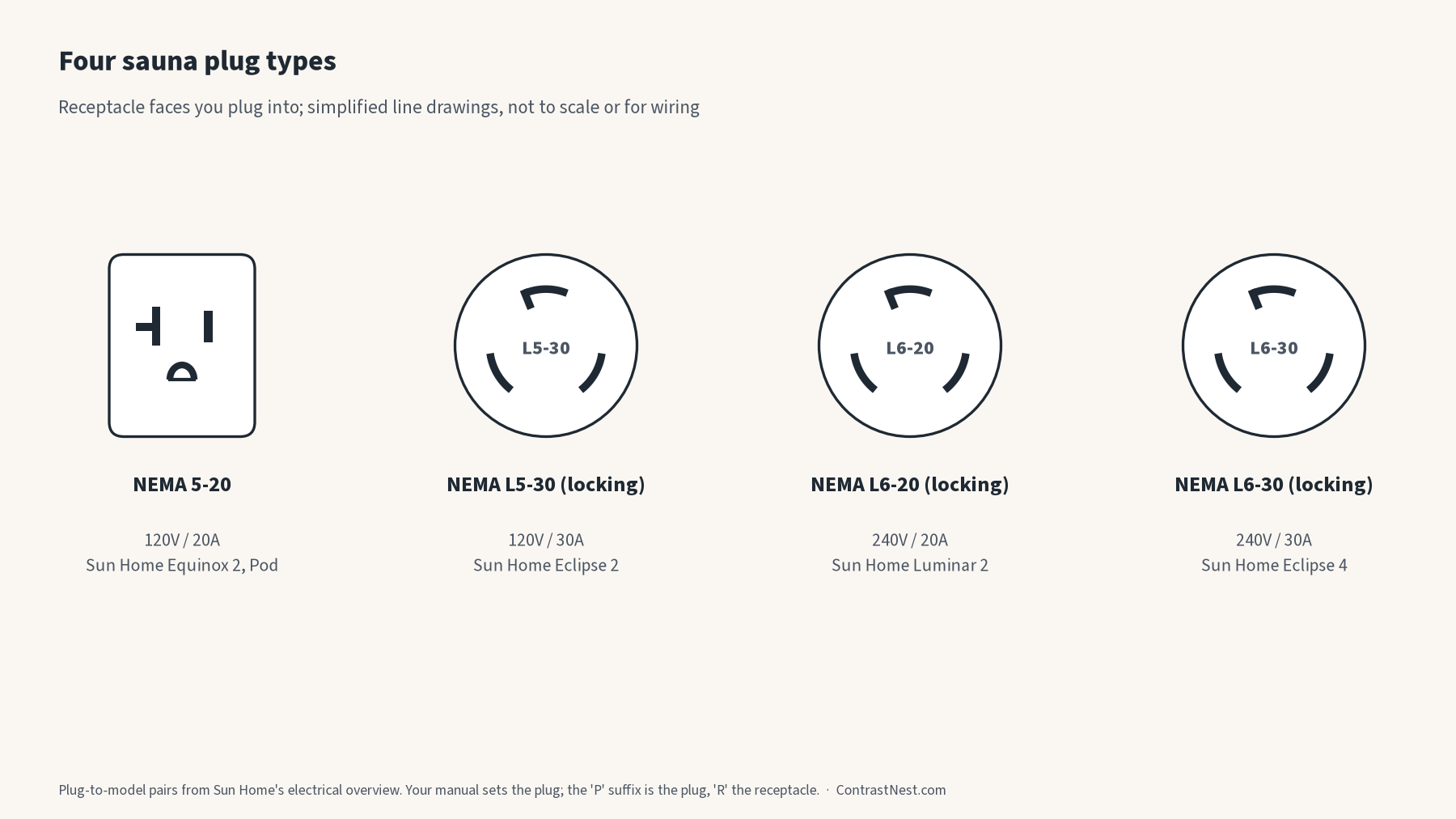
| Sun Home Pod (1 person) | 120V | 1,710W, 14.2A | Dedicated 20A, NEMA 5-20P, GFCI (maker) |
| Sun Home Equinox 2 | 120V | 1,880W, 15.67A | Dedicated 20A, NEMA 5-20P, GFCI (maker) |
| Sun Home Eclipse 2 | 120V | 2,820W, 23.5A | Dedicated 30A, locking NEMA L5-30P, GFCI breaker (maker) |
| Sun Home Luminar 2 (outdoor) | 240V | 4,800W | Dedicated 240V/20A, NEMA L6-20P, GFCI required |
| Sun Home Eclipse 4 | 240V | 5,300W, 22A | Dedicated 240V/30A, NEMA L6-30P |
| Sun Home Nova 3 (traditional) | 240V | 6 kW | Dedicated 240V/30A, hardwired |
| Almost Heaven Salem (traditional barrel) | 240V | 6 kW | 240V/30A, hardwired |
Sources: Sun Home electrical overview; Sun Home comparison; Wellness Matrix USA; Almost Heaven. Checked November 1, 2026; Sun Home and Dynamic specs re-checked November 3, 2026.
120V plug-in infrared (dedicated 15/20A)
“Plug-in” doesn’t mean any outlet. Sun Home asks for a dedicated circuit and outlet for every unit, “no other appliances on that breaker,” and no extension cords, power strips or surge protectors (Sun Home electrical overview). Sun Home’s comparison says an electrician is needed only if no dedicated 20A circuit already exists where the Equinox 2 or Pod will go (Sun Home comparison).
120V 30A twist-lock (Eclipse 2)
The Eclipse 2 is the in-between case. Its product page says the 2-person “runs on 120V,” and Sun Home’s electrical overview and comparison both list a dedicated 30A circuit with a locking NEMA L5-30P plug, and the comparison says you’ll need an electrician “in most homes” (Sun Home comparison). Model-by-model detail: Sun Home electrical requirements by model.
240V infrared cabins
Bigger and outdoor infrared cabins move to 240V. The Eclipse 4 uses a dedicated 240V/30A circuit with an L6-30P locking plug; the outdoor Luminar 2 uses 240V/20A, and Sun Home says GFCI is required (Sun Home electrical overview).
240V traditional heaters (all hardwired)
Traditional heaters are wired in permanently. Harvia’s KIP manual says the heater “must be permanently installed (no pigtails or plug allowed)” with wiring “done by a licensed electrician” (Harvia KIP manual). Sun Home lists its Nova 3 (6 kW) at 240V/30A and Nova 6 (7.5 kW) at 240V/40A, both hardwired with a licensed electrician required (Sun Home electrical overview). Not sure which type you want yet? Start with infrared vs traditional sauna.
What the code says (plain English, not legal advice)
The National Electrical Code (NFPA 70) is a model code. States and cities adopt editions, often with amendments. As of August 3, 2026, NFPA reports the 2026 NEC in effect in six states, the 2023 NEC in 20, the 2020 NEC in 15, and older editions or local adoption elsewhere (NFPA enforcement maps). Section numbers can shift between editions; check your inspector’s edition.
NEC Article 424: continuous load and the 125% rule
Sauna heaters generally fall under Article 424 (fixed space-heating equipment). An Article 424 explainer calls this a continuous load. Branch-circuit conductors and overcurrent devices must be rated at not less than 125% of the heating load (EC&M, Mike Holt, 2016). That 2016 article cites the older section number, 424.3(B); in the 2020 and 2023 editions the branch-circuit sizing rule sits in 424.4(B). A calculations workbook based on the 2023 NEC quotes 424.4(B): the branch-circuit conductors and overcurrent devices “shall not be less than 125% of the total load” (2023 NEC calculations sample, code-electrical.com).
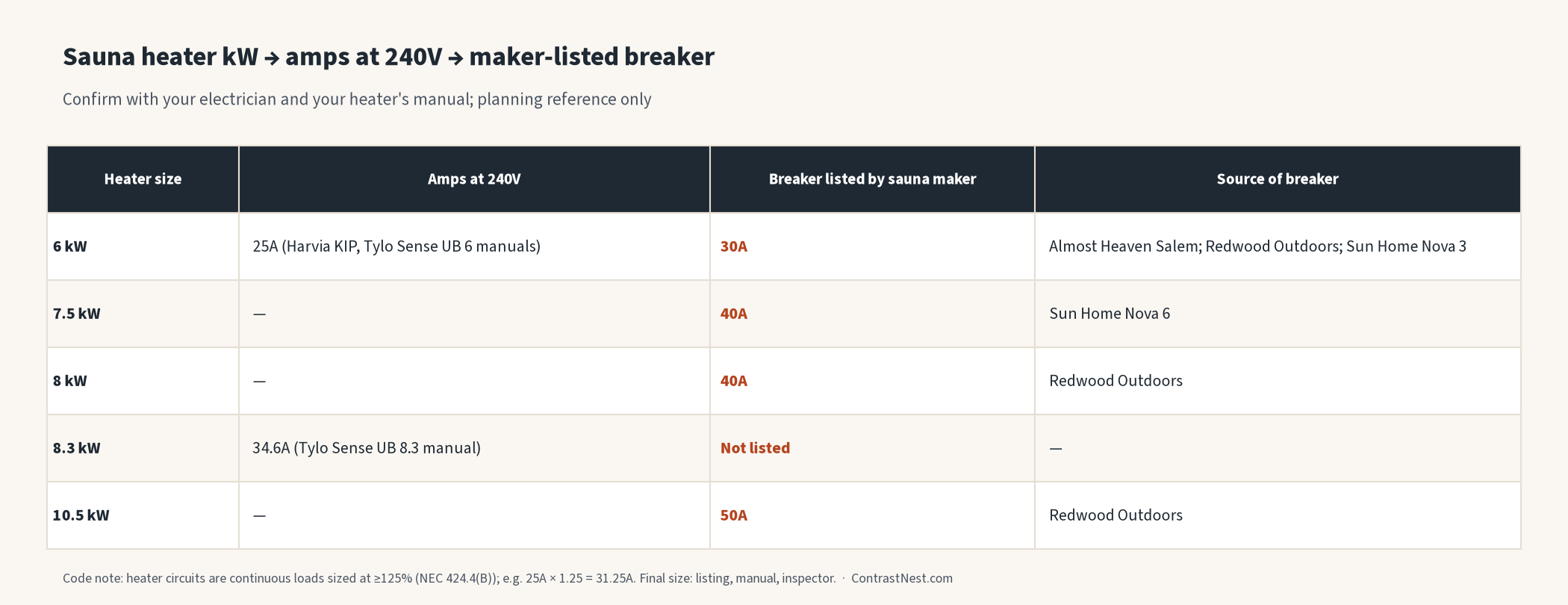
For a 6 kW heater at 240V, the load is 6,000 ÷ 240 = 25A, and 125% of that is 31.25A. The sauna makers in our guides list a 30A circuit for their 6 kW saunas (Almost Heaven; Sun Home Nova 3). The heater’s listing and manual, the code edition your jurisdiction uses, your inspector and a licensed electrician determine the final breaker and wire size. Don’t size it yourself.
Disconnecting means (424.19) and overcurrent protection (424.22)
Section 424.19 requires a disconnecting means for the heater and its controls. EC&M notes it must be lockable in the open position; its within-sight rule covers supplementary overcurrent devices. Your electrician places it (EC&M). Section 424.22 covers overcurrent protection for the equipment (NEC Article 424 outline, CodeBookCity).
NEC 110.3(B): follow the listing and manual
110.3(B) requires listed or labeled equipment to be installed according to the instructions included in the listing or labeling. Haven of Heat, a sauna retailer, calls this the code section “that matters most” for sauna heaters, because a manufacturer’s instruction then carries code weight (Haven of Heat).
GFCI: heater circuit vs nearby receptacles (210.8)
Section 210.8 lists where receptacles need GFCI protection (bathrooms, garages, outdoors and more), so a 120V plug-in sauna in a garage or basement may need it. Hardwired traditional heaters are different:
- Tylo: “A GFCI … device is not required by NEC. Only install a GFCI if required by local codes,” warning it “will cause nuisance electrical circuit trips” (Tylo Sense UB manual).
- Harvia KIP: “Heater must be connected to a standard 2-pole breaker, no GFI may be used,” and warranty on internal components is void if it’s on a GFI breaker (Harvia KIP manual).
- Sun Home infrared: the opposite. Its outdoor Luminar circuits list “GFCI required,” and outdoor outlets must be weather-protected and GFCI-protected (Sun Home electrical overview). Its 120V models do too: the Equinox 2 and Pod pages list a “Dedicated 20 Amp GFCI Circuit,” the Eclipse 2 page a “Dedicated circuit with a GFCI breaker”.
Inspectors can require GFCI where the base NEC doesn’t, especially outdoors (Haven of Heat). Resolve any manual-vs-inspector conflict before the install.
Reading a heater manual: kW, amps, wire and 90°C copper
Two manuals’ numbers, as printed:
| Heater (manual) | kW | Volts / phase | Amps | Wire size listed |
|---|---|---|---|---|
| Harvia KIP-60-B1 | 6.0 | 240V, 1-phase | 25.0 | #10/2 |
| Tylo Sense UB 6 | 6.0 | 240V, 1-phase | 25 | 2 #10 AWG + ground |
| Tylo Sense UB 8.3 | 8.3 | 240V, 1-phase | 34.6 | 2 #8 AWG + ground |
| HUUM DROP 6 kW (dealer listing) | 6.0 | 240V | 25 | Not listed on the dealer page |
Sources: Harvia KIP manual; Tylo Sense UB manual; Topture. Planning reference only; confirm with your electrician and your own heater’s manual.
Two details electricians look for:
- Heat-rated copper inside the sauna. Harvia says wiring within sauna walls and ceiling “must be rated 194°F (90ºC) and copper wire must be used” (Harvia KIP manual). Tylo says “copper wire only, temperature rated for a minimum of 90°C” (Tylo).
- Breaker size on the sauna listing. The Harvia manual table lists amps and wire, not the breaker. The sauna maker’s listing often does: Almost Heaven’s Salem, with a 6 kW Harvia heater, lists 240V/30A (Almost Heaven). Redwood Outdoors lists 30A for 6 kW, 40A for 8 kW and 50A for 10.5 kW Harvia heaters (Redwood Outdoors).
Panel capacity, load calcs and subpanels
A new 30A or 40A, 240V breaker needs two open slots and enough spare capacity in your service. Only an electrician’s load calculation answers that. Published planning ranges put a panel or service upgrade at about $1,500–$3,000 on top of the circuit itself (sauna.guide). Whether an outdoor sauna gets a subpanel is a design call for your electrician and inspector.
Outdoor saunas: trenching, feeders, disconnects, wet locations
Finest Saunas, a sauna maker, estimates $1,500–$5,000 for a trenched outdoor run (Finest Saunas). For its outdoor Solaris saunas, Sun Home notes that outdoor placement and the panel run “can take longer than a same-day install” and says to schedule electrical work ahead of delivery (Sun Home electrical overview). Ask your electrician about burial depth, the disconnect location, GFCI and wet-location-rated equipment under your local code. For pads, placement and venting, see home sauna setup guide.
What an electrician charges
We found no government or independent survey of sauna-specific electrical costs. These are published planning ranges and one owner report, labeled by source type:
| Source (type) | Scenario | Reported range |
|---|---|---|
| sauna.guide (sauna info site) | New 240V dedicated circuit | $600–$1,800 |
| sauna.guide | Panel/service upgrade, if needed | +$1,500–$3,000 |
| Finest Saunas (sauna maker) | Short accessible run / long or finished walls / trenched outdoor run | $500–$1,200 / $1,200–$3,000 / $1,500–$5,000 |
| Finest Saunas | Permit and inspection | $100–$500 |
| One r/Sauna owner (2025, owner-reported) | Swap an unused EV-circuit breaker for 30A, reroute it, add a disconnect, hardwire a barrel heater | About $1,300 quoted |
Sources: sauna.guide; Finest Saunas; r/Sauna thread.
Price drivers are distance from the panel, finished walls or a trench, spare panel capacity, local labor rates and permit fees (sauna.guide). Get at least two written, itemized quotes; Redwood Outdoors recommends the same (Redwood Outdoors). For the whole budget, see full home sauna cost breakdown.
Running cost is small next to the wiring. Energy cost per session = kW × hours × $/kWh. At the U.S. average 18.16¢/kWh (EIA, August 2026), a 6 kW heater running 1 hour costs up to about $1.09, and a 2,006W infrared cabin running 45 minutes about $0.27 (EIA Table 5.3). Upper bounds; heaters cycle.
Checklist to send your electrician
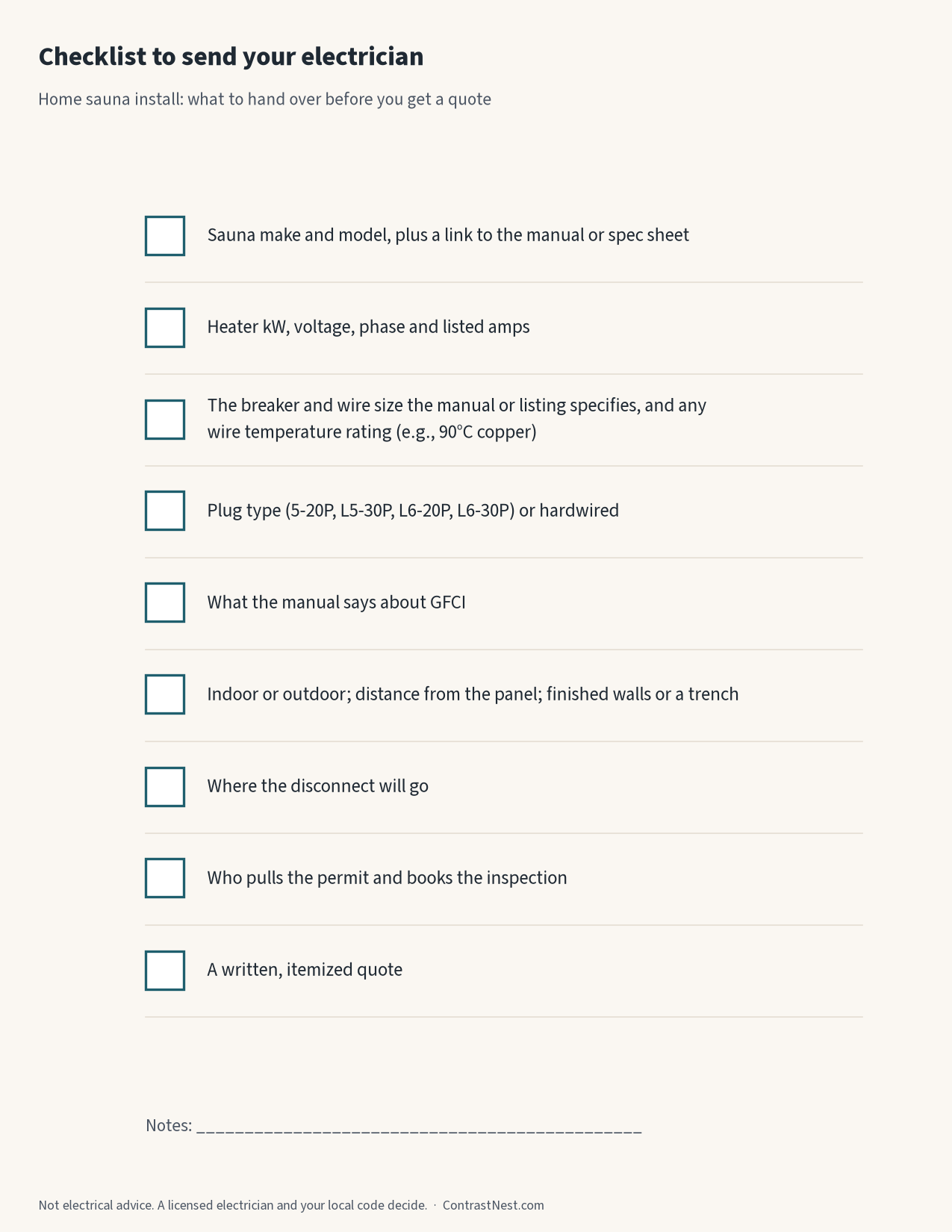
- Sauna make and model, plus a link to the manual or spec sheet
- Heater kW, voltage, phase and listed amps
- The breaker and wire size the manual or listing specifies, and any wire temperature rating (e.g., 90°C copper)
- Plug type (5-20P, L5-30P, L6-20P, L6-30P) or hardwired
- What the manual says about GFCI
- Indoor or outdoor; distance from the panel; finished walls or a trench
- Where the disconnect will go
- Who pulls the permit and books the inspection
- A written, itemized quote
Permits and inspection
Rules are set locally. Salt Lake County’s Municipal Services District requires a permit for “installing hot tubs, Jacuzzis, saunas, or spas” and for “adding, deleting, or altering any electrical circuits” (Greater Salt Lake MSD). Kirkland, Washington lists “saunas built on site” and electrical circuit extensions among projects needing permits (City of Kirkland). In general, a new circuit means an electrical permit; ask your electrician to pull it and call your building department before you order.
Common mistakes owners report
- GFCI on a heater whose manual forbids it. Tylo and Harvia both warn about nuisance trips, and Harvia voids internal-component warranty coverage (Harvia KIP manual). For hardwired heaters, one r/Sauna commenter agreed: the NEC doesn’t require GFI and most makers advise against it, though some localities require it. Sun Home’s 120V plug-in models do specify GFCI (r/Sauna thread).
- Undersized wire or the wrong breaker. Harvia says warranty on parts is void if the installer fails to follow its wiring information or code “for proper wire size, amperage” (Harvia KIP manual).
- Reusing an existing circuit. In one r/Sauna thread, commenters told an owner that a 60A switch doesn’t mean the wire or breaker is rated for 60A, and that the heater needs its own circuit (r/Sauna thread).
- Extension cords and shared outlets for plug-in cabins. Sun Home rules out both (Sun Home electrical overview).
Health note: Talk to your doctor before using a sauna or cold plunge, especially if you are pregnant or have a heart condition, low or high blood pressure, or another health condition. See our Health Disclaimer.
Safety note: Sauna use isn’t right for everyone. People with heart or blood-pressure conditions should check with a doctor first (Harvard Health). Medical disclaimer: This is educational information, not medical advice.
FAQs
Does a sauna need special wiring?
Usually a dedicated circuit: 15A, 20A or 30A at 120V for infrared by model, or a hardwired 240V circuit for traditional heaters.
What are the wiring requirements for a sauna?
Whatever your heater’s manual and listing specify, under your local code edition.
How much does it cost for an electrician to hook up a sauna?
sauna.guide puts a new 240V circuit at about $600–$1,800, plus $1,500–$3,000 if the panel needs an upgrade (sauna.guide); Finest Saunas estimates $1,500–$5,000 for a trenched outdoor run (Finest Saunas).
What wire should I use for a sauna?
The size in your manual. Harvia and Tylo list #10 AWG for their 6 kW, 240V models and Tylo lists #8 AWG for 8.3 kW.
Do all saunas require 240V?
No. The Equinox 2, Pod and Eclipse 2 run on 120V. Traditional heaters and some large infrared cabins need 240V.
Does a sauna require a 220 outlet?
“220” is everyday shorthand for U.S. 240V. Traditional heaters are hardwired with no outlet. Some 240V infrared cabins use a locking plug, like the Eclipse 4’s L6-30P.
What are the electrical code requirements for a sauna?
Per EC&M’s summary of NEC Article 424 and a 2023 NEC calculations reference (125% sizing in 424.4(B), disconnect in 424.19, overcurrent protection in 424.22), plus 110.3(B) for the listing, and 210.8 for GFCI receptacles. Confirm with your electrician or inspector.
Does a sauna heater need a GFCI breaker?
Not under the base NEC for hardwired traditional heaters, per Tylo’s manual, and Harvia forbids one on the KIP. Sun Home’s product pages call for GFCI protection on its infrared circuits (a GFCI breaker on the 30A twist-lock Eclipse 2). Your manual and inspector decide.
The bottom line
Check the manual, then the panel, then hire an electrician who pulls a permit. A 120V infrared cabin may need nothing more than a free dedicated outlet; a traditional heater means a new 240V circuit and usually $600–$1,800 or more.
Last updated: November 3, 2026. Specs, code adoption and prices change; see the dates in each section.