
ContrastNest is reader-supported. When you buy through links on this page we may earn a commission, at no extra cost to you. Our guides are research-based and AI-assisted, and checked against sources; we don’t claim hands-on testing. Affiliate Disclosure →
How we researched this. This explainer is research-based. We compiled it from manufacturer spec pages, a peer-reviewed dermatology review, a controlled study, standards summaries, retailer explainers and owner discussions, all checked on November 1, 2026. We have not tested, used, measured or owned any sauna mentioned here. We did not measure any heater’s output.
Quick verdict
A far infrared sauna uses carbon or ceramic panels that emit long-wave infrared. A full spectrum sauna adds emitters, usually halogen or quartz tubes, that are marketed as covering near and mid infrared too. In the two same-brand lines we priced, full spectrum cost about $600–$700 more at Sun Home and roughly $2,400–$3,400 more at Sunlighten, as of November 2026.
What you reliably get for that money is more radiant heat and higher maximum temperatures. Sun Home rates its full-spectrum Equinox 2 to 165°F (Sun Home, checked Nov 1, 2026), versus up to 140°F for its far-infrared Solstice (Sun Home Solstice 2). What you don’t reliably get is “red light therapy.” Near infrared from a hot heater is not the same as an LED red-light panel, and the evidence for wavelength-specific health benefits in saunas is thin.
Pick far infrared if you want a lower price, simpler parts and a gentler heat. Pick full spectrum if you want a hotter cabin and accept more components that can wear out. For red light, look for dedicated LED panels. Model picks: Best Infrared Saunas for Home (2026): A Research-Based Buyer’s Guide.
Near, mid and far infrared in plain English
Wavelength ranges
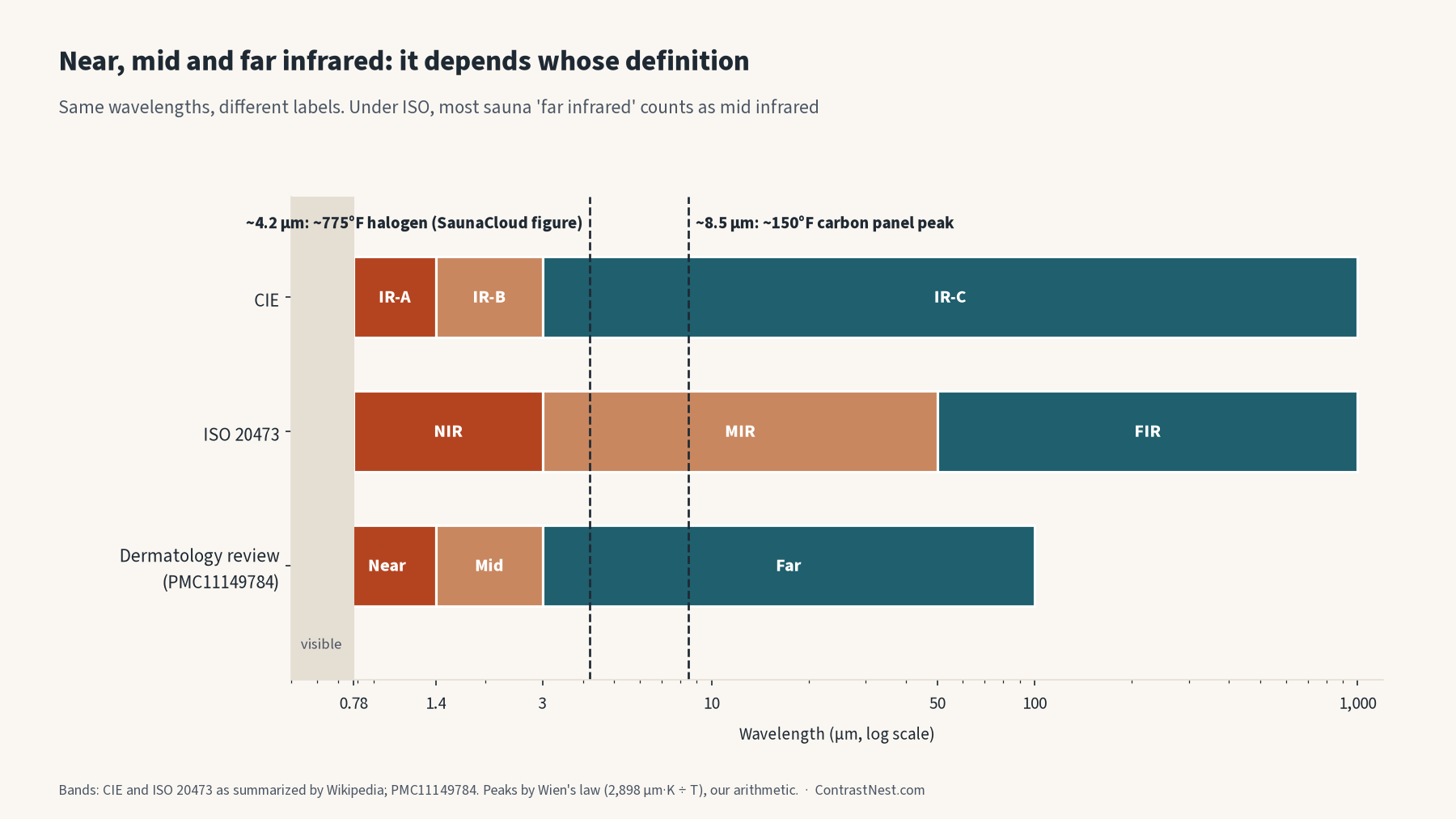
Infrared is light just past visible red, felt as warmth. Standards divide it differently, which lets marketing get slippery:
| Scheme | Near | Mid | Far |
|---|---|---|---|
| CIE (lighting/photobiology) | IR-A: 0.78–1.4 µm | IR-B: 1.4–3 µm | IR-C: 3–1,000 µm |
| ISO 20473 | NIR: 0.78–3 µm | MIR: 3–50 µm | FIR: 50–1,000 µm |
| Dermatology review of infrared saunas | 0.7–1.4 µm | 1.4–3.0 µm | 3.0–100 µm |
Sources: band values for the CIE and ISO 20473 schemes as summarized by Wikipedia, “Infrared” (ISO’s text is paywalled); sauna subtypes from a peer-reviewed review (PMC11149784). The sauna industry generally uses the CIE-style split. Under the ISO scheme, most of what sauna makers call “far infrared” would technically count as mid infrared. When a brand quotes wavelengths, ask which scheme it means.
Halogen/quartz vs carbon vs ceramic emitters
The physics behind the labels: any hot object emits a spread of infrared, and the hotter the emitter, the shorter its peak wavelength. This is Wien’s displacement law: peak wavelength ≈ 2,898 µm·K ÷ temperature in kelvin. Applying it:
- A surface at about 150°F (339 K) peaks near 8.5 µm, in the far band. Sun Home says standard carbon panels operate at 140–150°F (Sun Home).
- A surface at about 775°F (686 K) peaks near 4.2 µm. SaunaCloud, a brand that sells far-infrared saunas, gives that temperature for halogen tubes and argues their output is mostly mid infrared (SaunaCloud).
- Peaking in the near band (under 1.4 µm) requires an emitter above roughly 2,070 K (about 3,265°F), by our arithmetic. That’s filament territory, not a warm panel.
| Emitter | Typical role | Strengths | Trade-offs |
|---|---|---|---|
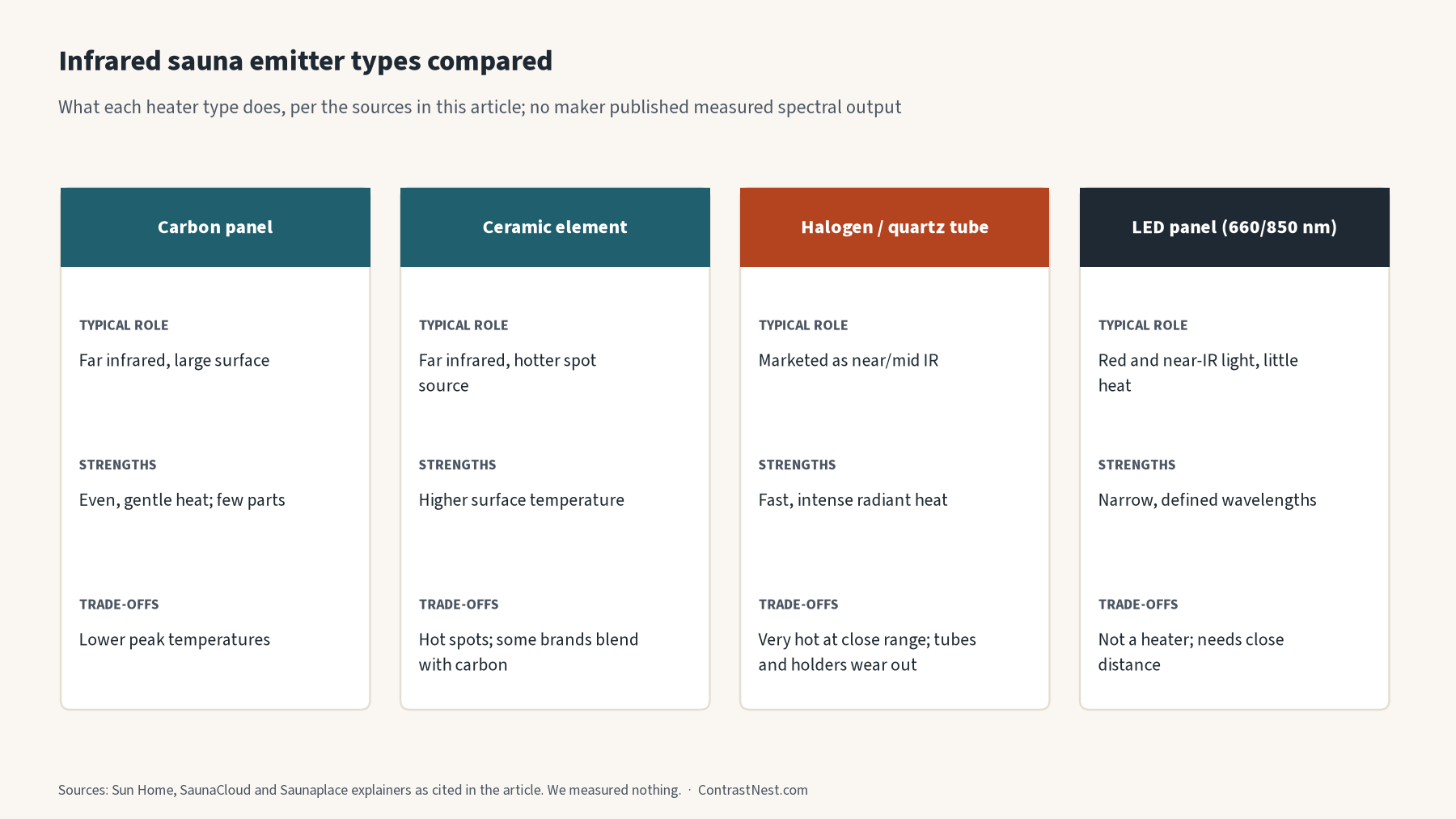
| Carbon panel | Far infrared, large surface | Even, gentle heat; few parts | Lower peak temperatures |
| Ceramic element | Far infrared, hotter spot source | Higher surface temperature | Hot spots; some brands blend with carbon |
| Halogen / quartz tube | Marketed as near/mid IR | Fast, intense radiant heat | Very hot at close range; tubes and holders wear out |
| LED panel (660/850 nm) | Red and near-IR light, little heat | Narrow, defined wavelengths | Not a heater; needs close distance |
Both brand sources sell competing products, and neither published measured spectral output; we measured none. Saunaplace, a retailer selling both types, claims halogen bulbs are “finite” while carbon panels last “30,000 plus hours” (Saunaplace). That’s a retailer’s claim, not a manufacturer rating.
Full spectrum is not red light therapy
LED photobiomodulation vs halogen heat lamps
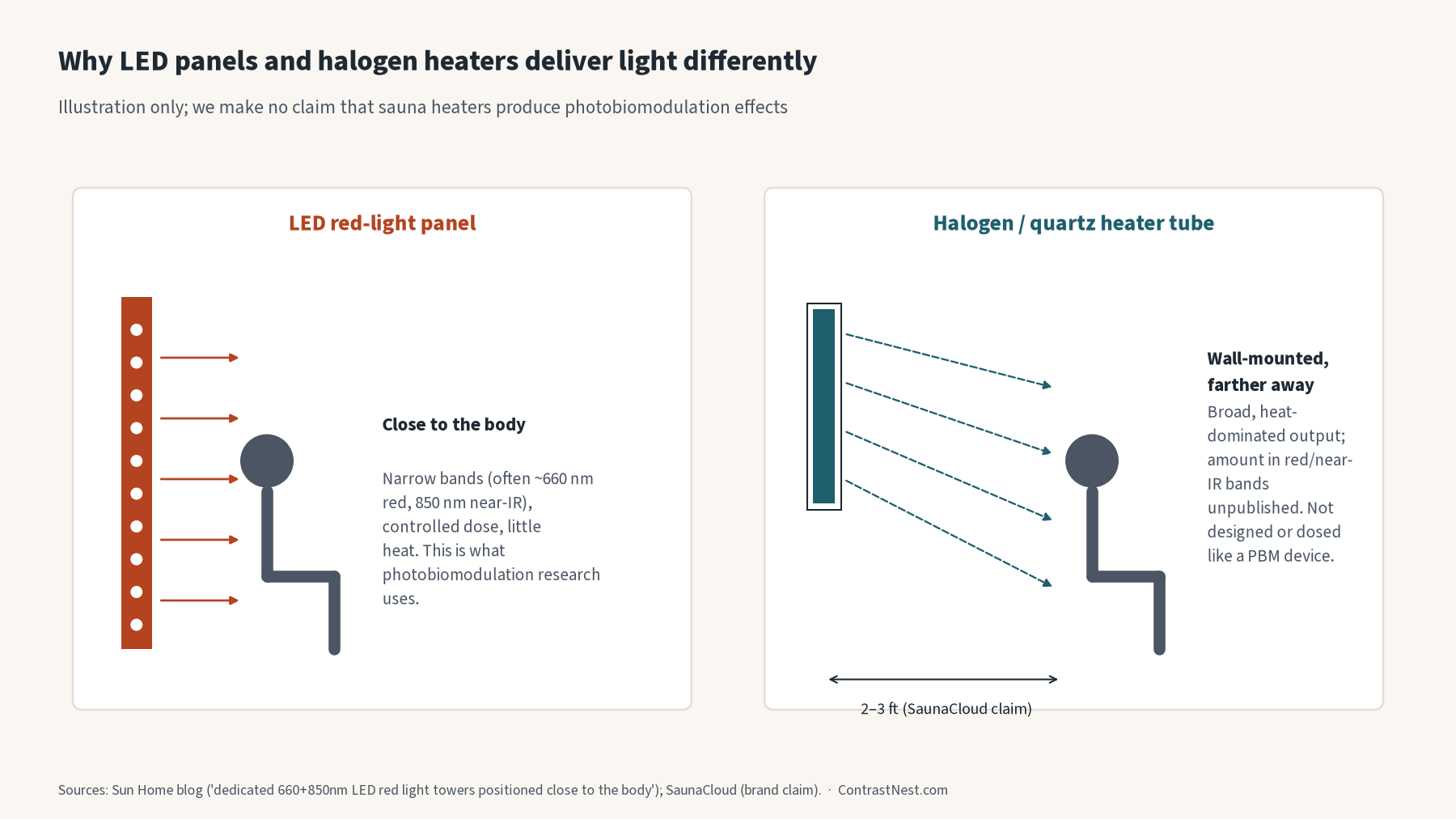
“Photobiomodulation” (PBM) research typically uses LEDs or lasers at specific wavelengths (often around 660 nm red and 850 nm near infrared), delivered at a controlled dose from a short distance. A halogen heater emits a broad, heat-dominated spread with an unpublished amount in those bands. It isn’t designed or dosed like a PBM device.
Even full-spectrum sellers draw this line:
- Sun Home says buyers who want photobiomodulation should look for “dedicated 660+850nm LED red light towers positioned close to the body” (Sun Home blog).
- SaunaCloud (a brand claim) argues panels two to three feet away deliver too little light to matter (SaunaCloud).
We make no claim that near infrared from sauna heaters produces PBM effects. If red light matters to you, compare models with built-in LED panels (such as the Sun Home Eclipse, with 650 nm and 850 nm panels) in Best Infrared Saunas for Home (2026): A Research-Based Buyer’s Guide.
What the evidence says (and doesn’t)
- Infrared saunas in general: Mayo Clinic says studies of infrared saunas for conditions including high blood pressure, heart failure, dementia and Alzheimer’s disease, headache, type 2 diabetes and arthritis “found some proof that saunas may help,” but “larger and more-exact studies are needed.” Mayo also says “no harmful effects have been reported with infrared saunas” (Mayo Clinic).
- Marketing vs research: Northwestern Medicine describes infrared research as mostly small and short-term, and warns that marketing “may overstate expected benefits” (Northwestern Medicine).
- Skin claims: a peer-reviewed review found many online claims of skin benefits (“cleansing,” “clearing,” detox), concluding these “have not been validated in the limited literature” and that potential dangers to skin are unclear (PMC11149784).
- Far infrared vs traditional: a small 2025 study (n=20) found core temperature rose about 0.4°C in a traditional sauna and essentially not at all in a far-infrared session under its conditions (PubMed 40332494). We found no comparable controlled study of full-spectrum vs far-infrared cabins.
- Long-term associations: the best-known cohort data link frequent traditional sauna use with lower cardiovascular mortality in Finnish men (PubMed 25705824). That’s an association, not proof of cause, and it says nothing about full spectrum.
Bottom line: we found no credible evidence full spectrum is healthier; the proven difference is cabin heat. Bigger picture: Infrared vs Traditional Sauna: Heat, Cost, Health Evidence and Which to Buy.
Price gap: same-brand comparisons
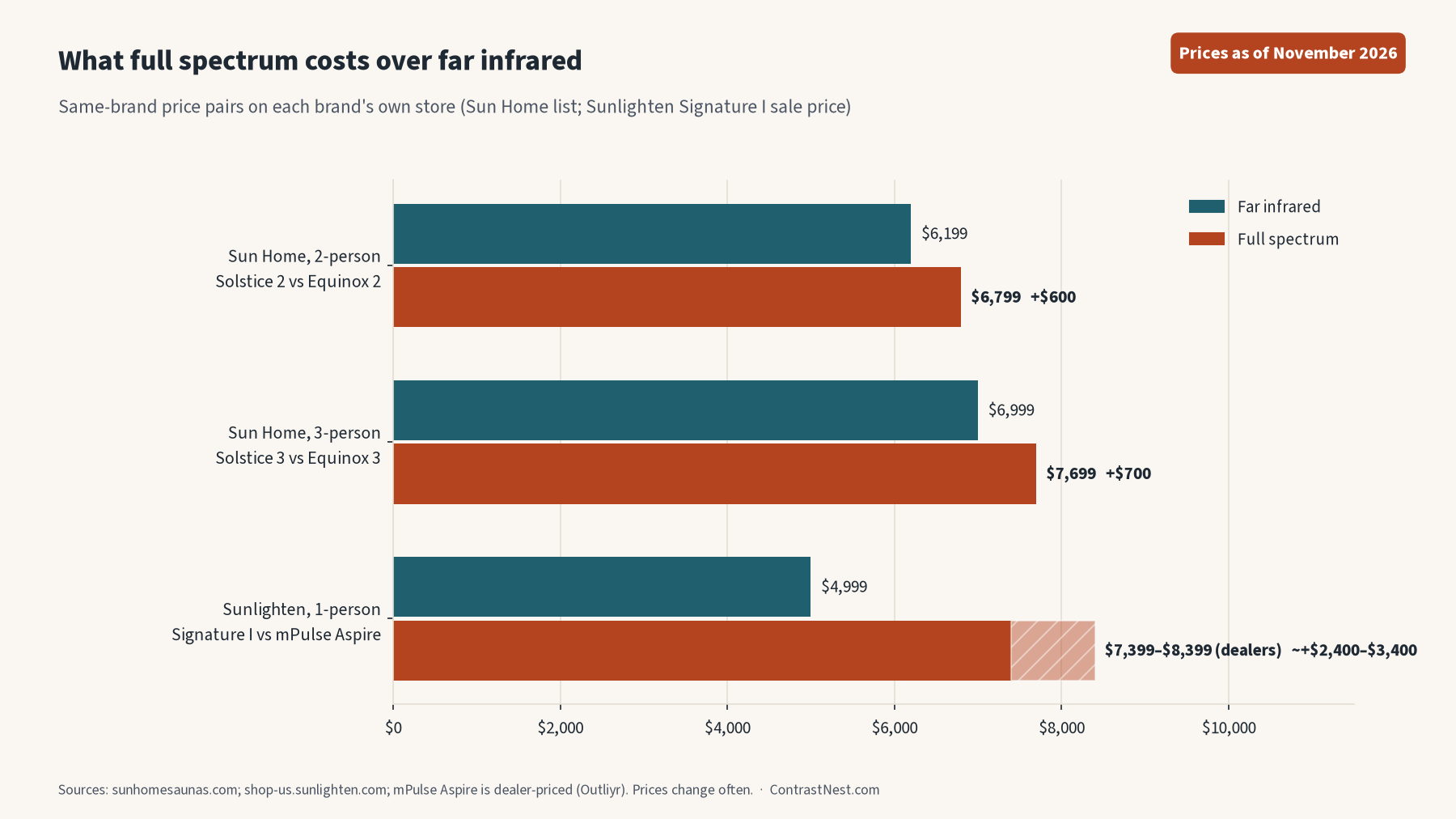
Prices on each brand’s own store as of November 2026 (Sun Home at list price; Sunlighten’s sale price), unless noted.
| Brand | Far infrared model | Price | Full spectrum model | Price | Premium |
|---|---|---|---|---|---|
| Sun Home (2-person) | Solstice 2 | $6,199 | Equinox 2 | $6,799 | +$600 |
| Sun Home (3-person) | Solstice 3 | $6,999 | Equinox 3 | $7,699 | +$700 |
| Sunlighten (1-person) | Signature I (Eucalyptus) | $4,999 | mPulse Aspire | ~$7,399–$8,399 (dealers) | ~+$2,400–$3,400 |
Sun Home Solstice vs Equinox
- Solstice (far infrared): eucalyptus interior; Sun Home lists up to 140°F (Sun Home Solstice 2); 7-year warranty, replacement parts only. The 2-person model is 2,006W on a 120V/20A circuit (Sun Home).
- Equinox (full spectrum): eucalyptus interior, up to 165°F, 7-year warranty, replacement parts only (Sun Home warranty). The 2-person model is 1,880W on a dedicated 120V/20A GFCI circuit with a NEMA 5-20P plug.
- Heater types: Sun Home says the Equinox 2 is full spectrum, “pairing full-spectrum heaters with far-infrared panels” (Sun Home Solstice 2). Sun Home doesn’t name the emitter technology (halogen or carbon).
The full-spectrum Equinox 2 is rated at lower wattage than the far-infrared Solstice 2 yet a higher maximum temperature. Wattage alone doesn’t set heat. Our Sun Home Saunas Review (2026): Is Sun Home Worth It? A Lineup-Wide Research Review review goes deeper.
Sunlighten Solo/Signature vs mPulse
- Solo System (far, lie-down): $2,099 (Sunlighten).
- Signature I (far, 1-person): $4,999 sale, $5,499 list; SoloCarbon far-infrared heaters; dedicated 120V/20A circuit (Sunlighten).
- mPulse Aspire (full spectrum + red, 1-person): Sunlighten shows “consultant pricing,” not a price. Dealers listed it at ~$7,399–$8,399. It has separately controllable red, near, mid and far heaters (5 far, 4 mid, 3 red/near) and runs on 120V, 2,160W, 20A, NEMA 5-20P per an authorized dealer (Relax & Retreat; Outliyr).
- In between: Sunlighten’s Amplify II (full spectrum, 2-person) is $5,999 on sale ($6,899 list) as of November 2026. Sunlighten says it uses SoloCarbon far-infrared plus halogen heaters and reaches 170°F “in ideal conditions.”
Clearlight, for context: the full-spectrum Sanctuary 2 pairs two 500W full-spectrum heaters with carbon/ceramic far-infrared heaters on 120V/20A. Clearlight’s US price list showed $7,299 basswood ($7,899 regular) and $7,699 mahogany ($8,299 regular), labelled as early Black Friday pricing for orders placed by November 30, as of November 2026 (Clearlight). We don’t link to it: Clearlight’s affiliate program excludes the Sanctuary line from commission.
Practical differences: heat feel, bulb life, replacement parts, electrical
- Heat feel: in our source set, full-spectrum cabins are rated hotter: 165–170°F (Sun Home Equinox, Sunlighten Amplify) versus up to 140°F for Sun Home’s far-infrared Solstice (Sun Home Solstice 2). Halogen tubes give intense, directional heat on whatever they face. Carbon panels feel more even.
- Bulb life: none of the manufacturers we checked publish a rated life in hours for their full-spectrum emitters. Saunaplace notes halogen bulbs are “finite,” and reports seeing units whose near-infrared emitters failed after replacement parts were discontinued.
- Replacement cost: none of the manufacturers we checked publish full-spectrum emitter prices. As a market reference only, an Australian aftermarket retailer lists generic quartz-halogen sauna heater tubes at about AU$103–$111 each, and warns that tube holders also degrade with heat (Red Earth Saunas). Ask the brand for emitter part prices.
- Warranty: Sun Home gives both its far (Solstice) and full-spectrum (Equinox) lines 7 years, replacement parts only, so the upgrade doesn’t add warranty risk there. Elsewhere, check whether emitters are covered for as long as the cabin.
- Electrical: spectrum doesn’t decide the circuit. The 2-person Solstice and Equinox both need a dedicated 120V/20A circuit, as does Sunlighten’s Signature. Larger full-spectrum cabins and models with red light can need 30A or 240V. Examples: Sun Home Eclipse 2 (120V/30A L5-30P) and Eclipse 4 (240V).
- Running cost: roughly the same. At the U.S. average 18.16¢/kWh (EIA, August 2026), a 2,006W cabin used for 45 minutes costs about $0.27 per session at full rated draw, or about $3.55 a month at 13 sessions. The 1,880W Equinox 2 works out to about $0.26. See Home Sauna Cost (2026): Purchase, Installation, 240V Electrical and Running Cost.
What owners say (forum synthesis)
Paraphrased from r/infraredsauna; these are individual opinions, not verified by us:
- In the top-ranking “FAR vs full spectrum” thread, several commenters argued far infrared does most of the work and that build quality and heater coverage matter more than the label. A Sun Valley Saunas representative said far infrared is a fine first purchase (thread).
- In an August 2026 thread about upgrading, one commenter suggested a separate red/near-infrared panel instead of a new cabin (thread).
- A 2025 commenter argued the near-infrared output of full-spectrum heaters is small and called it a buzzword (thread).
Who should pick which
Choose far infrared if you:
- want the lowest price for a given size and brand
- prefer gentler, even heat (around 120–140°F)
- want fewer parts to wear out
- may add a separate red-light panel later
Choose full spectrum if you:
- want a hotter cabin (165–170°F ratings in our sources) without going traditional
- like intense, fast radiant heat
- will check emitter warranty and parts first
See 2-person full spectrum options.
Don’t choose on health grounds. For much higher heat, see Infrared vs Traditional Sauna: Heat, Cost, Health Evidence and Which to Buy.
Safety: who should be careful
Health note: Talk to your doctor before using a sauna or cold plunge, especially if you are pregnant or have a heart condition, low or high blood pressure, or another health condition. See our Health Disclaimer.
- Heat and dehydration: drink water, start with short sessions and leave if you feel dizzy, nauseated or unwell.
- Pregnancy: avoid or ask your doctor first. Poison Control says pregnant women are generally advised to avoid sauna use; Northwestern Medicine lists pregnancy as a reason for caution.
- Heart conditions and blood pressure: heat raises heart rate and can lower blood pressure. Ask a doctor first if you have heart disease, low blood pressure or high blood pressure (Northwestern Medicine; Harvard Health).
- Medications: some drugs affect heat tolerance. Poison Control says people using transdermal medication patches should avoid saunas.
- Alcohol: don’t combine alcohol with sauna use (Northwestern Medicine; Harvard Health).
- Children: Poison Control says children are generally advised to avoid saunas.
- Skin and close emitters: Northwestern Medicine notes repeated close heat exposure can cause erythema ab igne, a mottled rash. Halogen tubes run very hot, so keep skin away from them.
- Cold plunges after: if you alternate with cold water, sudden cold raises heart rate and blood pressure. People with heart or blood-pressure conditions should get medical advice first. See Infrared vs Traditional Sauna: Heat, Cost, Health Evidence and Which to Buy for contrast-therapy cautions.
FAQs
What is the difference between a far infrared sauna and a full spectrum sauna?
A far infrared sauna uses carbon or ceramic panels that emit long-wave infrared at relatively low surface temperatures. A full spectrum sauna adds hotter emitters, usually halogen or quartz tubes, marketed as near and mid infrared. In practice, full-spectrum models in our sources run hotter (165–170°F vs up to 140°F for the Solstice (Sun Home Solstice 2)) and cost more: about $500–$700 at Sun Home and ~$2,400–$3,400 at Sunlighten in our comparisons.
What is the healthiest type of infrared sauna?
There’s no evidence that one type is healthiest. Mayo Clinic says larger studies are still needed to confirm infrared sauna benefits in general, and we found no controlled comparison of full-spectrum vs far-infrared cabins. The healthiest choice is the one you can use safely and consistently, after checking with your doctor if any of the safety notes apply.
Who should not use a far infrared sauna?
Anyone who is pregnant, has heart disease or low or high blood pressure, takes medications that affect heat tolerance, or has been drinking alcohol should get medical advice first or avoid it. Poison Control says children are generally advised to avoid saunas. These cautions apply to all saunas, not just far infrared.
Why not shower after infrared sauna?
We found no credible source advising against it. The idea comes from “detox” marketing, which a peer-reviewed review found unvalidated (PMC11149784). Rinsing off is about comfort. If you take a cold shower and have a heart or blood-pressure condition, ask your doctor first.
Do full spectrum saunas get hotter?
Generally, yes, in the models we checked. Sun Home rates its full-spectrum Equinox to 165°F and its far-infrared Solstice up to 140°F (Sun Home Solstice 2). Sunlighten says its full-spectrum Amplify reaches 170°F “in ideal conditions.” Actual temperatures depend on room conditions, insulation and the circuit.
The bottom line
Full spectrum buys heat, not health gains or red light therapy. Compare: Best Infrared Saunas for Home (2026): A Research-Based Buyer’s Guide.
Disclaimer: Educational information, not medical advice. Talk to your doctor before using a sauna, especially if you are pregnant, have a heart or blood-pressure condition, or take medication. ContrastNest.com has not tested these products; confirm prices and specs with the seller.