
ContrastNest is reader-supported. When you buy through links on this page we may earn a commission, at no extra cost to you. Our guides are research-based and AI-assisted, and checked against sources; we don’t claim hands-on testing. Affiliate Disclosure →
The short answer: the 200 rule says a traditional sauna’s air temperature in °F plus its relative humidity in % should add up to about 200, for example 180°F at 20% humidity. It’s a comfort rule of thumb popularized in North America. It isn’t a Finnish standard, a medical guideline or a safety limit, and it doesn’t apply to infrared saunas (Crateworks; Home Sauna Guide).
How we researched this: This guide is research-based. We have not tested or measured any sauna, heater or gauge mentioned. It’s compiled from sauna-maker and retailer guides, a heater-controller manual, peer-reviewed studies, health organizations and cited owner comments, all checked on November 1, 2026; links re-checked November 3, 2026.
The 200 rule in one sentence
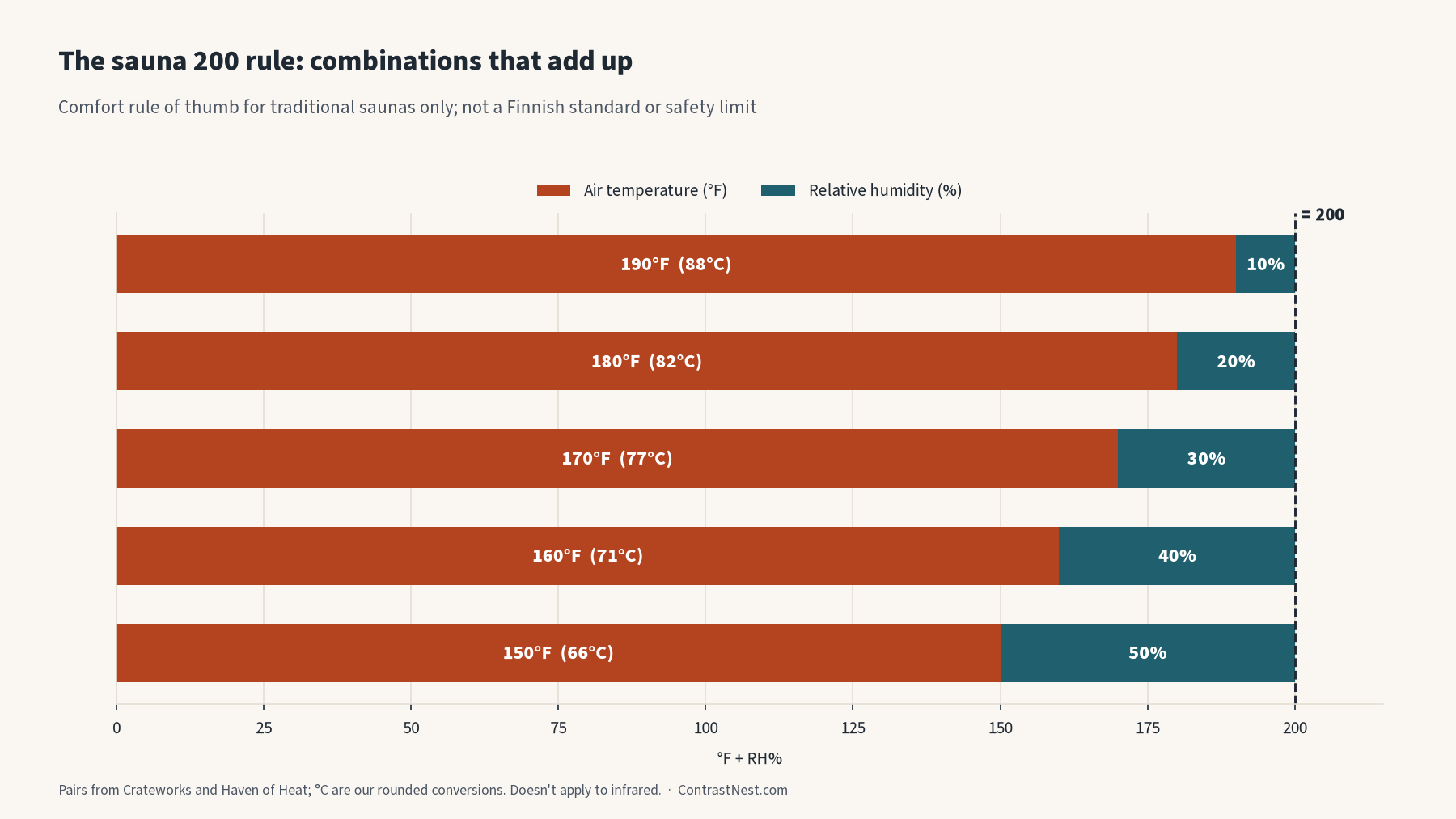
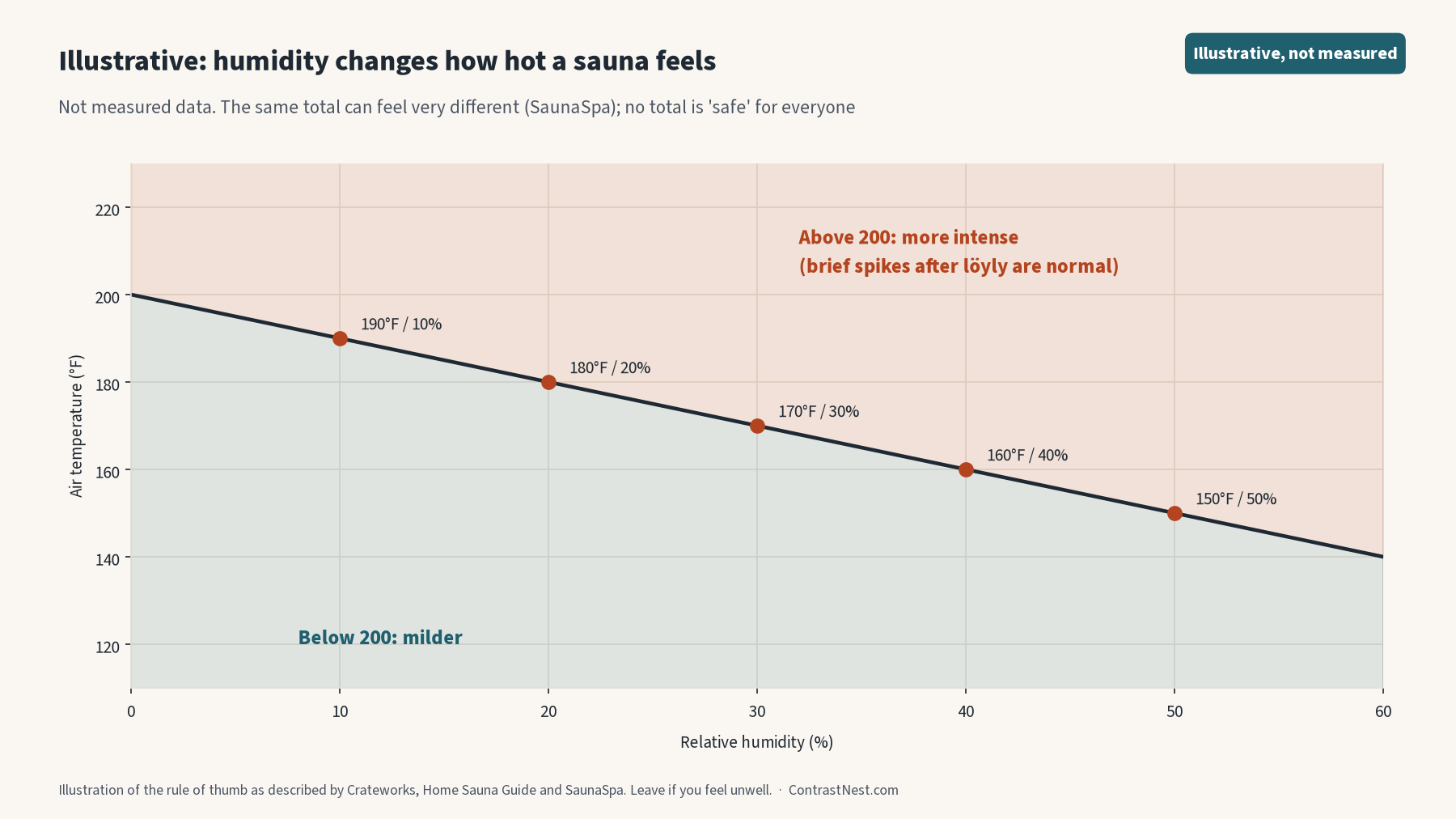
Temperature (°F) + relative humidity (%) ≈ 200. A drier room can run hotter; a steamier room feels just as intense at a lower temperature. The common pairings below each add up to 200 (Crateworks; Haven of Heat). Celsius figures are our conversions, rounded.
| Air temperature | °C (approx.) | Humidity for a total of 200 |
|---|---|---|
| 150°F | 66°C | 50% |
| 160°F | 71°C | 40% |
| 170°F | 77°C | 30% |
| 180°F | 82°C | 20% |
| 190°F | 88°C | 10% |
The same total doesn’t mean the same sauna: SaunaSpa, a Canadian sauna builder, notes that 190°F/10% and 160°F/40% can feel very different (SaunaSpa).
Where the rule comes from
The rule is often called “Finnish,” and the evidence we found doesn’t support that:
- Finland uses Celsius. A rule that adds Fahrenheit to a percentage is unlikely to be Finnish (SaunaSpa).
- No Finnish source states it. Crateworks found no Finnish Sauna Society publication and no heater maker, including Harvia and HUUM, that publishes a rule of 200 (Crateworks). SaunaSpa reached a similar conclusion and calls it “a modern, Fahrenheit-based rule of thumb.”
- Retailers trace it to North America. Haven of Heat, a US sauna retailer, says it “appears to have been popularized in the North American sauna community,” likely by heater makers and retailers. Home Sauna Guide calls it a rule of thumb from the US (Home Sauna Guide).
- There’s no Celsius version. Some sites mention a “rule of 100” (80°C plus 20%), but Crateworks calls it informal, and SaunaSpa notes it isn’t mathematically equivalent.
A 2026 Jyväskylä study (50 adults, four 10-minute sessions) found temperature and humidity were each independently associated with heart rate and core temperature (Laatikainen-Raussi et al., Temperature, 2026). Harvia provided the saunas and infrastructure and paid publication costs; Toyota partly funded measurement. It didn’t test the rule.
How to measure temperature and humidity
You need a thermometer and a hygrometer (a humidity gauge). Combined units are common.
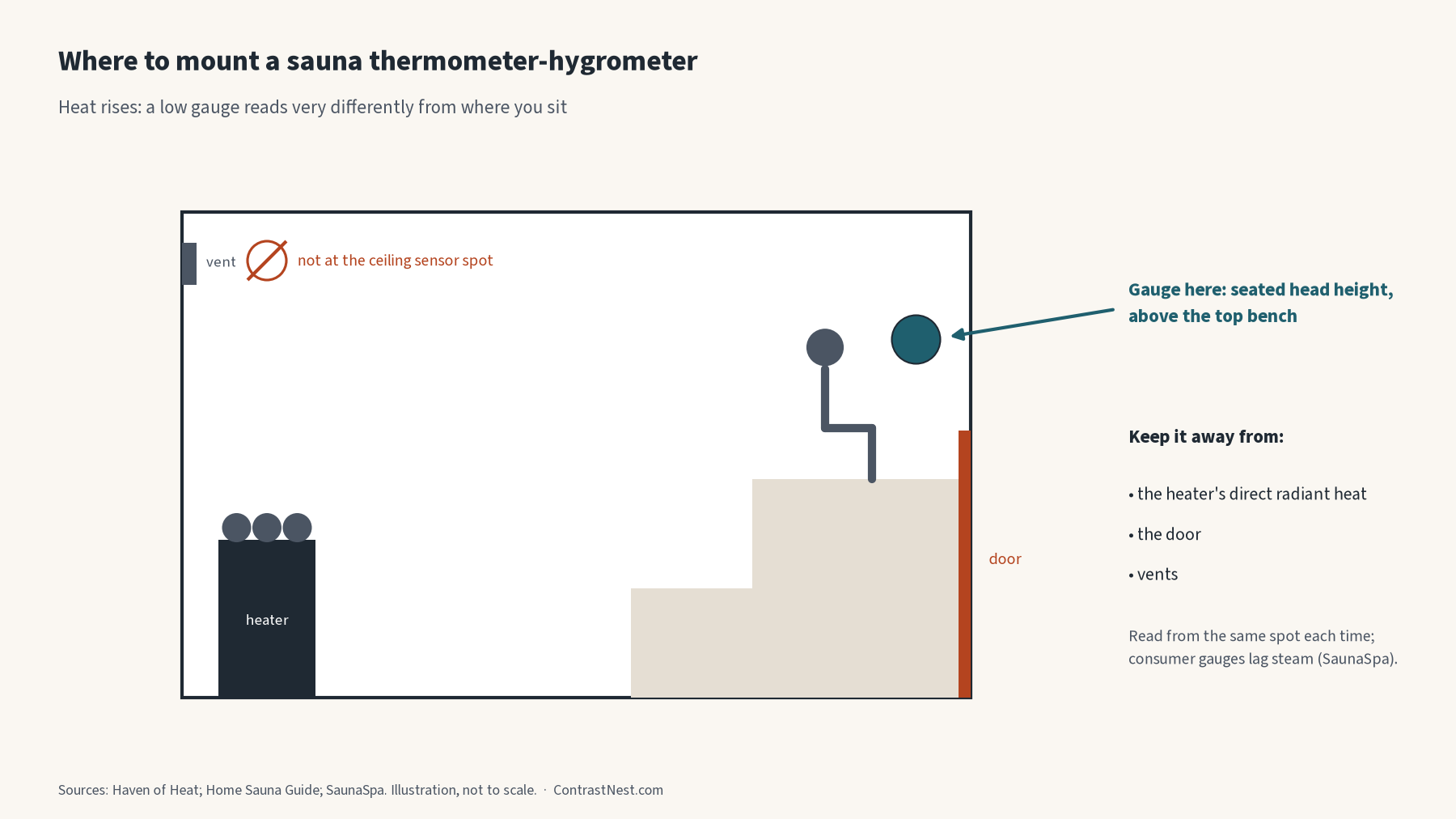
Placement matters because heat rises. The controller’s sensor is often near the ceiling, so Home Sauna Guide suggests a gauge at head height above the top bench to show what you’re actually sitting in. Haven of Heat says to mount it at seated head height, away from the heater’s direct radiant heat and away from the door and vents. In one published barrel-sauna log, the floor stayed about 20–22°C (36–40°F) below bench level even after ventilation changes (Saunologia), so a low gauge will read very differently.
Controllers with humidity readouts exist. HUUM’s UKU 4.2 manual describes a bench sensor that measures temperature and relative humidity. Its allowed humidity setting drops as temperature rises, to 5–10% at 85–90°C, and humidity control turns off above 90°C (HUUM UKU 4.2 manual).
Expect rough numbers. SaunaSpa warns consumer gauges aren’t lab instruments and may lag behind a wave of steam; read from the same spot each time.
Ventilation shapes both readings; see sauna ventilation and humidity.
Löyly: why humidity spikes are normal
A traditional sauna is fairly dry between pours. Poison Control describes dry saunas at 10–20% relative humidity (Poison Control). Ladling water on the hot stones creates löyly, a burst of steam that raises humidity for a minute or two. Sweat evaporates more slowly, so the room feels much hotter even though the thermometer barely moves (Home Sauna Guide).
So the total will often jump past 200 for a moment. Crateworks says “a brief spike above 200 when you pour water is normal” because the rule describes the room you sit in, not the moment steam hits. Home Sauna Guide adds that Finnish bathers often go over it briefly.
Only pour water on a stone heater designed for it, following its manual. SaunaSpa warns never to pour water on infrared panels or other electrical parts not made for water.
Room shape matters too; see barrel vs cabin sauna heat.
Does the 200 rule apply to infrared?
No. Infrared saunas have no stones or steam, so there’s no humidity to tune (Haven of Heat; SaunaSpa). Mayo Clinic says infrared “heats your body directly without warming the air around you” (Mayo Clinic), and Northwestern Medicine puts infrared air at “usually around 120 to 140 degrees Fahrenheit” (Northwestern Medicine).
Not sure which type you want? See infrared vs traditional sauna.
Is it a safety rule? What the research does say
No. SaunaSpa states there’s “no established scientific evidence showing that a total below 200 is automatically safe or that a total above 200 is automatically dangerous,” and that the rule ignores session length, hydration, alcohol, medications, pregnancy, age and illness. Crateworks agrees: a total under 200 doesn’t make a session safe. No combination is “safe” for everyone. Leave if you feel unwell.
Session length and frequency in studies
The best-known data come from the Kuopio cohort (Laukkanen et al., JAMA Internal Medicine, 2015). It followed 2,315 middle-aged men in eastern Finland for a median 20.7 years. Compared with one session a week, 4–7 sessions a week were associated with lower risk of sudden cardiac death, fatal heart disease and death from all causes. Sessions longer than 19 minutes were associated with lower risk of sudden cardiac death than sessions under 11 minutes (PubMed 25705824).
It’s observational (association, not cause), it studied Finnish men aged 42–60 only, and it reports what people did, not a prescription.
Harvard Health suggests staying in no more than 15–20 minutes, cooling down gradually and drinking two to four glasses of water afterward (Harvard Health). For infrared versus traditional, a 2025 study found no significant difference in the rise in cardiac output between the two (P = 0.06) (PubMed 40332494).
Who should be cautious
Health note: Talk to your doctor before using a sauna or cold plunge, especially if you are pregnant or have a heart condition, low or high blood pressure, or another health condition. See our Health Disclaimer.
Heat safety:
- Dehydration: sweating causes fluid loss. Drink fluids before and after, and leave right away if you feel dizzy, lightheaded or nauseated or have palpitations (Poison Control).
- Pregnancy: Poison Control says pregnant women are generally advised to avoid sauna use. Ask your doctor first.
- Heart conditions and blood pressure: ask your doctor first if you have heart disease or uncontrolled high blood pressure (Harvard Health). People with low blood pressure should use caution, because blood pressure can drop after sauna use (Poison Control).
- Medications and patches: Poison Control says people using transdermal medication patches, such as nicotine and nitroglycerin patches, should avoid saunas, because heat can increase absorption. Stimulants alter the body’s response to heat, and combined with sauna use they “may result in life-threatening hyperthermia and death.” Ask your doctor or pharmacist about any medication.
- Alcohol: Poison Control says alcohol around sauna use may increase the risk of sudden death, so avoid it.
- Children: Poison Control says children are generally advised to avoid saunas.
- Recent illness: Harvard Health says not to take a sauna when you’re ill (Harvard Health).
Common myths
“Sweating out toxins.” Poison Control notes that some toxic metals appear in sweat, but “there is no proof that sweat-induced toxin elimination is associated with actual health benefits” and “no conclusive evidence that sauna use is an effective detoxification method” (Poison Control). A 2018 commentary, “Can POPs be substantially popped out through sweat?”, questions the idea (Imbeault et al., 2018).
“Hotter is better.” Higher heat isn’t a goal. Home Sauna Guide advises starting low and turning it up a few degrees at a time. SaunaSpa calls 200 “a reference point, not a performance target.” On Reddit, one r/Sauna member described the rule as the point past which it gets very uncomfortable, and said about 170°F at 20% suits them for 15-minute rounds (r/Sauna). That’s one person’s preference, not advice.
FAQs
What is the 200 rule for saunas?
A comfort rule of thumb for traditional saunas: °F plus relative humidity % should total about 200, such as 170°F at 30% or 180°F at 20%. Not a Finnish standard or safety limit.
How long can a human stay in a 200 degree sauna?
No time limit is safe for everyone, and a “200” total isn’t a 200°F room. Harvard Health suggests no more than 15–20 minutes. Leave if you feel dizzy or unwell.
Why shouldn’t you sauna every day?
We found no evidence that daily use is harmful for healthy adults. In the Kuopio study, 4–7 sessions a week were associated with lower cardiovascular risk in Finnish men, but that’s observational and not a recommendation. Ask your doctor what suits you.
Does a sauna actually sweat out toxins?
No good evidence says so. Poison Control finds no conclusive evidence that sauna use is an effective detox method.
Does the 200 rule apply to infrared saunas?
No. Infrared has no steam, so there’s no humidity to balance.
What is the rule of 200 in Celsius?
There isn’t an established one. Converted, the pairs are about 66°C/50%, 71°C/40%, 77°C/30%, 82°C/20% and 88°C/10%. The “rule of 100” (80°C plus 20%) is informal.
The bottom line
Use the 200 rule to understand that steam makes heat feel hotter, not as a target or safety line. Measure at seated head height, expect spikes when you pour water, and ignore it for infrared. Planning a build? See home sauna cost.
Medical disclaimer: Educational information, not medical advice. Talk to your doctor before using a sauna, especially if you are pregnant, have a heart or blood-pressure condition, or take medication.