
ContrastNest is reader-supported. When you buy through links on this page we may earn a commission, at no extra cost to you. Our guides are research-based and AI-assisted, and checked against sources; we don’t claim hands-on testing. Affiliate Disclosure →
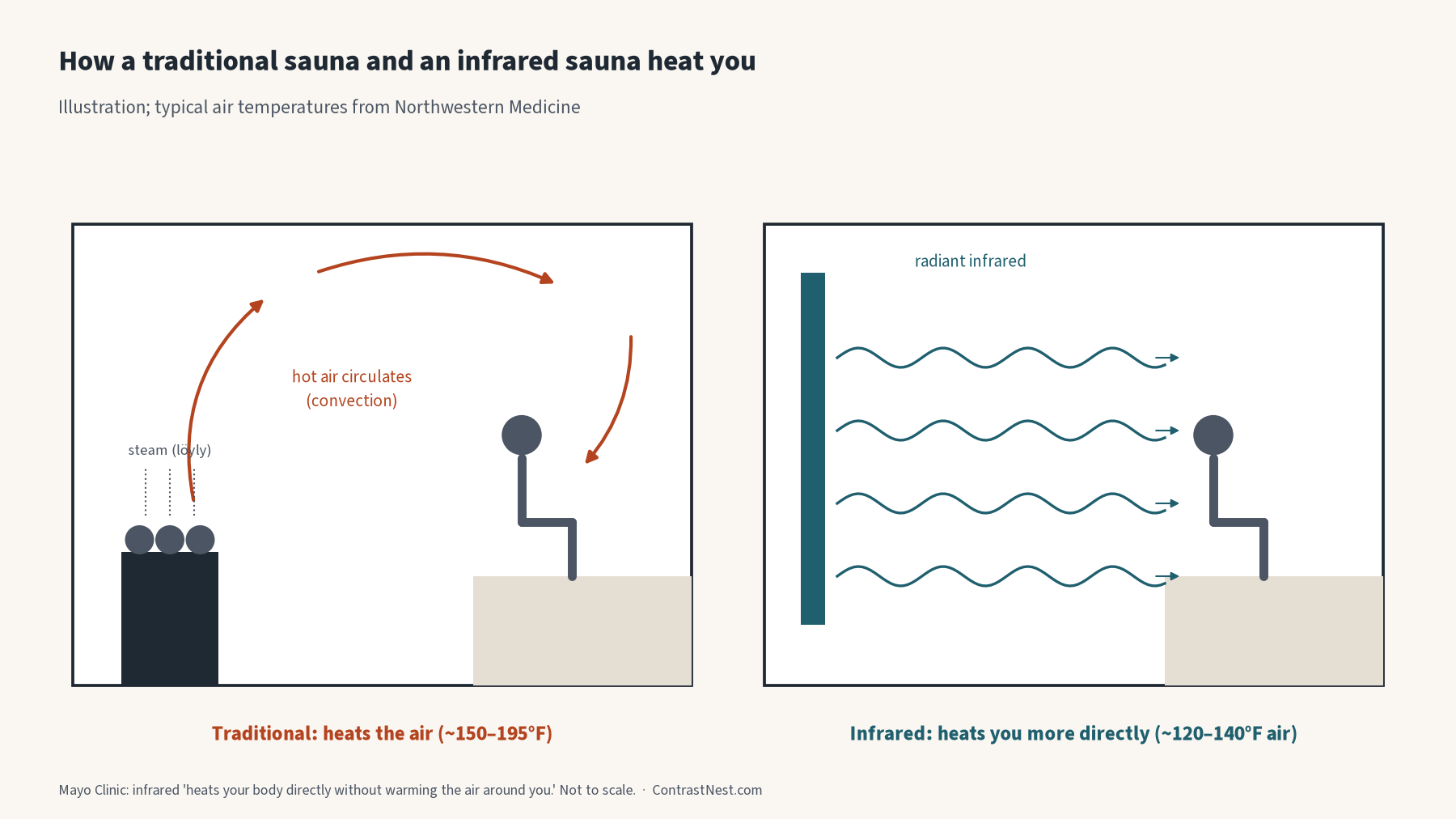
The short version: A traditional sauna heats the air, usually to about 150-195°F. You can pour water on hot stones to make steam. An infrared sauna uses emitters that warm your body more directly, at a much lower air temperature, usually around 120-140°F (Northwestern Medicine).
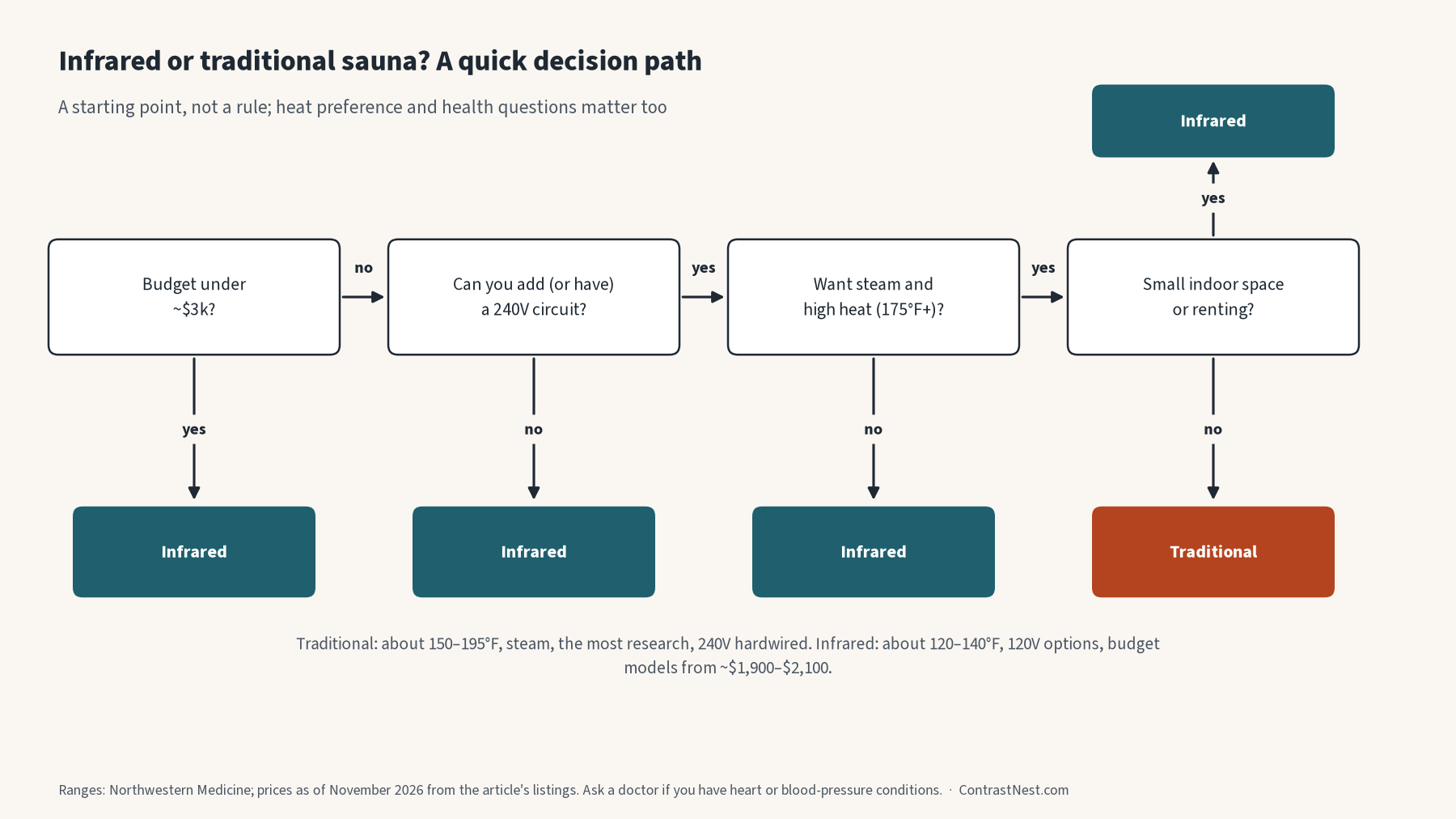
Pick traditional for real heat, steam and the most research, if you can add a 240V circuit. Pick infrared if budget, space or a 120V plug-in setup matters more than peak heat.
How we researched this: This guide is research-based. We have not tested, used or measured any of the saunas mentioned, and we don’t own them. We put it together from manufacturer spec pages, U.S. government electricity data, peer-reviewed studies, guidance from medical institutions, and public owner discussions. Every source is linked, and we checked all of them on November 1, 2026; prices, warranties and links were re-checked on November 3, 2026. Prices change often. Treat every price here as an approximate snapshot as of November 2026.
Quick comparison
| Traditional (Finnish-style) sauna | Infrared sauna | |
|---|---|---|
| How it heats | Heater warms air and stones; air heats you | Emitters warm your body directly; air stays cooler |
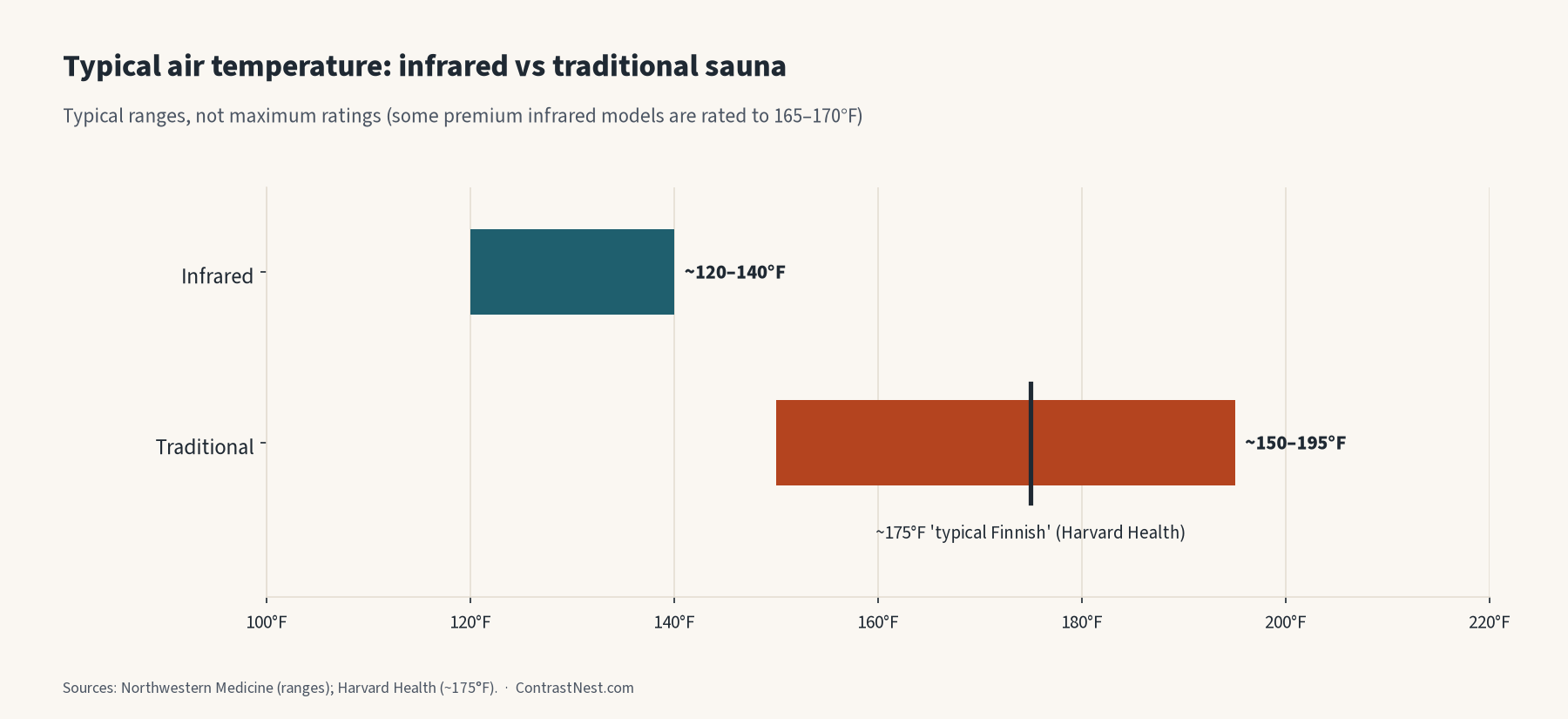
| Typical air temperature | ~150-195°F | ~120-140°F |
| Steam (löyly) | Yes, ladle water on stones | No |
| Typical heat-up | ~20-35 min (properly sized heater; can be longer) | ~10-20 min to “ready to sweat” |
| Typical power (examples below) | 6 kW heater, 240V/30A hardwired | ~1.3-2.3 kW, many on a 120V outlet |
| Est. energy cost per session* | ~$1.09 (upper-bound estimate) | ~$0.27 |
| Research base | Large long-term observational studies | Mostly small, short-term studies |
*Our estimates at the U.S. average electricity price; formula and sources below.
The short answer (decision box)
Choose traditional if…
- You want high heat (175°F and up) and steam, the classic Finnish-style experience.
- You can install, or already have, a 240V dedicated circuit. Most electric sauna heaters, like the 6 kW examples below, are hardwired.
- You want the type of sauna used in most of the long-term studies (see the research section).
- You have room outdoors for a barrel or cabin, or a dedicated indoor space. Planning one now? See Barrel Sauna vs Cabin Sauna: Heat, Cost, Climate and Durability Compared for our barrel vs cabin sauna comparison.
Choose infrared if…
- Your budget is closer to $2,000 than $10,000.
- You want a 120V plug-in setup (many need their own dedicated 120V circuit, which is cheaper and simpler than 240V), or you rent.
- You don’t handle intense heat well and prefer a gentler, lower-temperature session. Mayo Clinic calls infrared “a choice for people who can’t stand the heat of a sauna” (Mayo Clinic).
- You have a small indoor footprint. A one- or two-person cabin is roughly the size of a closet.
Still unsure? Northwestern Medicine suggests spa or gym saunas as a way to “try different types of saunas before buying” (Northwestern Medicine).
How each one heats you
Traditional: heats air + stones (about 150-195°F)
A traditional sauna, also called a Finnish sauna or dry sauna, uses an electric or wood-burning heater with a basket of stones. The heater warms the room air, and the hot air warms you. Northwestern Medicine puts traditional sauna air at “typically between 150 to 195 degrees Fahrenheit” (Northwestern Medicine). Harvard Health describes a typical Finnish sauna as “around 175° F” (Harvard Health). Almost Heaven lists electric-heater saunas at 150-195°F with 10-20% humidity (Almost Heaven).
“Dry sauna” is a misleading name: a Finnish sauna still gets bursts of humidity from water on the stones.
Infrared: emitters heat the body (about 120-140°F)
Mayo Clinic says infrared “heats your body directly without warming the air around you” (Mayo Clinic). Air temperature is “usually around 120 to 140 degrees Fahrenheit” (Northwestern Medicine). Sun Home lists its far-infrared Solstice at up to 140°F (Sun Home Solstice 2). Some premium full-spectrum and outdoor models are rated to 165-170°F (Sun Home Equinox 2; Sun Home Luminar 5). Far infrared vs full spectrum is a separate decision: see full spectrum vs far infrared.
Real heat-up difference. Saunafin, a distributor that sells both types, says infrared units heat up in about 10-20 minutes. A properly sized traditional sauna takes 20-35 minutes. Saunafin also notes it “generally takes 12-20 minutes of exposure” to start sweating in infrared (Saunafin PDF). Estimates vary by source: published figures for traditional saunas range from about 20 to 45 minutes (Sun Valley Saunas, for example, says 30-45 minutes; see Home Sauna Cost (2026): Purchase, Installation, 240V Electrical and Running Cost).
Steam (löyly) and the 200 rule
Water ladled onto hot stones makes a burst of steam called löyly, which makes the heat feel stronger. Infrared saunas have no stones, so no löyly.
The “200 rule”: air temperature in °F plus relative humidity in % should add up to about 200 (for example, 180°F at 20% humidity). It’s a comfort rule of thumb. It’s not a Finnish standard, a medical guideline, or a safety limit, and it doesn’t apply to infrared (Crateworks; Home Sauna Guide). For a deeper look, see the 200 rule explained.
Side-by-side comparison table
Here are three real reference models plus typical ranges. All specs come from manufacturer or dealer pages checked November 1, 2026; prices were re-checked November 3, 2026. We have not verified any of them in person.
| Spec | Sun Home Nova 3 (traditional) | Almost Heaven Salem (traditional barrel) | Sun Home Solstice (far infrared) | Dynamic Barcelona (budget infrared) |
|---|---|---|---|---|
| Heat source | 6 kW HUUM DROP electric heater + stones | 6 kW Harvia electric heater + stones | Far-infrared emitters | 6 carbon far-infrared panels |
| Max / typical temp | Max 230°F (listed) | Electric-heater sauna range 150-195°F (brand guide) | Up to 140°F (listed) | Ideal 118-132°F, max 140°F |
| Electrical | 240V, dedicated 30A, hardwired | 240V, 30A, hardwired (+ 110V/15A for lighting) | 1-3 person: 120V/20A dedicated; 4-person: 240V/20A | 120V/15A, dedicated outlet recommended |
| Rated power | 6 kW | 6 kW | 1,350-2,750 W by size | Not published on the pages we checked |
| Approx. price (as of November 2026) | ~$12,500 | from ~$4,500 (plus install if needed) | ~$5,600-$8,600 depending on size | ~$1,900-$2,100 |
| Warranty | Limited lifetime (Sun Home defines “lifetime” as 7 years; replacement parts only) | Limited lifetime (cabin); Harvia heater 1 yr elements / 5 yr other parts | 7 years (replacement parts only) | 5 years heaters/electronics, 1 year wood structure |
| Where to look | Sun Home Nova Traditional Sauna | Almost Heaven Salem Barrel Sauna | Sun Home Solstice Infrared Sauna | Dynamic Barcelona Infrared Sauna |
Sources: Nova (product page, electrical overview); Salem (Almost Heaven); Solstice (Sun Home collection, electrical overview); Barcelona (Wellness Matrix USA, Dynamic Saunas Direct).
Note: The Nova and Solstice are made by the same brand, which makes for a cleaner comparison of the two technologies. The Solstice prices come from Sun Home’s infrared collection page, which lists four far-infrared sizes between roughly $5,599 and $8,599 as of November 2026. Check the exact size you want before buying.
More in our Sun Home Saunas review.
Cost: purchase, install, 240V and running cost
Typical price ranges
Based on the listings above (as of November 2026), budget plug-in infrared cabins start around $1,900-$2,100. Premium-brand infrared runs about $5,600-$14,500. Traditional barrel kits start around $4,500 and go to roughly $17,600 for large Harvia-collection models at Almost Heaven (Almost Heaven barrel collection). A premium indoor traditional cabin like the Nova 3 is about $12,500. Almost Heaven lists professional installation “starting at $1,400” (Almost Heaven). For permits, foundations and electrician quotes, see our full home sauna cost breakdown.
120V plug-in vs 240V hardwire
- Traditional electric heaters in our examples are 6 kW and hardwired to a dedicated 240V/30A circuit. Sun Home says a licensed electrician installs that circuit, and you should have it done before delivery (Sun Home Nova). Almost Heaven’s Salem lists the same 6 kW, 240V, 30A hardwire requirement (Almost Heaven).
- Many infrared cabins run on 120V, but “plug-in” doesn’t mean any outlet will do. Sun Home says all its saunas need a dedicated circuit, “never a shared household outlet,” and no extension cords (Sun Home electrical overview). The Solstice 1-3 person models list 120V/20A. The Barcelona lists 120V/15A with a dedicated outlet recommended.
Always have a licensed electrician check your panel and local code.
Running cost per session: formula + labeled assumptions
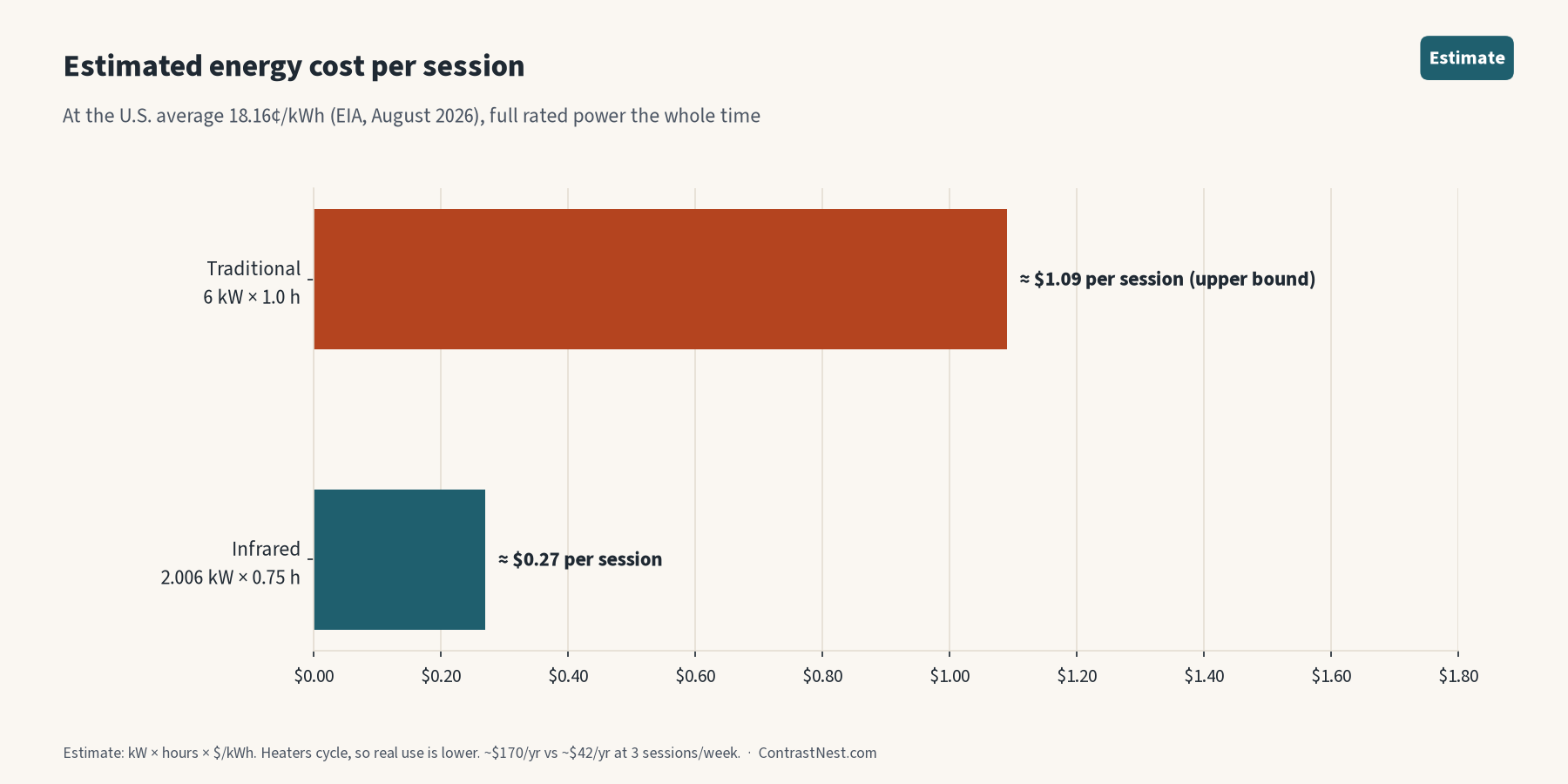
Formula: heater power (kW) × hours running × electricity price ($/kWh) = energy cost per session.
Assumptions (estimates, not measurements):
- Electricity price: 18.16¢/kWh, the U.S. average residential price for August 2026, the latest month available (EIA Electric Power Monthly, Table 5.3). Your rate may be much higher or lower.
- Traditional: 6 kW heater × 1.0 hour (about 30 min heat-up + 30 min session). Heaters cycle on and off once they reach temperature, so assuming full power the whole hour gives an upper bound.
- Infrared: 2.006 kW (Sun Home Solstice 2-person rated wattage) × 0.75 hour (about 15 min warm-up + 30 min session), also at full rated draw.
| Calculation | Est. cost per session | Est. cost, 3 sessions/week × 52 | |
|---|---|---|---|
| Traditional (6 kW) | 6 × 1.0 × $0.1816 | ≈ $1.09 | ≈ $170/yr |
| Infrared (2.0 kW) | 2.006 × 0.75 × $0.1816 | ≈ $0.27 | ≈ $42/yr |
Infrared costs about a quarter as much per session, but the gap is only about $10-$11 a month at three sessions a week. Upfront cost and wiring usually matter more.
What the health research does and doesn’t show
Before anything else: a sauna is not a treatment, and nothing here is medical advice. Here’s what credible sources say, and where they stop.
Traditional sauna studies (Finnish cohort)
The best-known study followed 2,315 middle-aged Finnish men for a median of about 21 years. Men who reported using a sauna 4-7 times a week had a lower risk of fatal cardiovascular events and death from any cause than men who went once a week (Laukkanen et al., JAMA Internal Medicine, 2015, PubMed). It’s an observational study, which means it found an association and can’t prove that the sauna caused the difference. The authors themselves called for more research. Harvard Health adds that a lifestyle that allows for frequent sauna use might help explain the results (Harvard Health). Those participants used traditional Finnish saunas.
Infrared studies
Mayo Clinic says studies have looked at infrared saunas for conditions including high blood pressure, heart failure, dementia and Alzheimer’s disease, headache, type 2 diabetes and arthritis, and “found some proof that saunas may help.” It adds that “larger and more-exact studies are needed” (Mayo Clinic). A Northwestern Medicine physician describes infrared research as “mostly limited to small, short-term studies.” She also warns that much infrared marketing borrows from traditional sauna data “and may overstate expected benefits” (Northwestern Medicine).
Head-to-head 2025 study
A 2025 University of Oregon study compared a traditional sauna (3 × 10 minutes at 80°C/176°F), a far-infrared sauna (45 minutes at 45-65°C) and hot-water immersion in 20 healthy young adults. Core temperature rose by about 0.4°C in the traditional sauna and about 0.0°C in the far-infrared sauna, which was a statistically significant difference. The rise in cardiac output was not significantly different between the two saunas. Hot-water immersion produced the largest responses (Atencio et al., Am J Physiol Regul Integr Comp Physiol, 2025, PubMed). It’s one small study and doesn’t measure long-term outcomes.
Bottom line: The strongest long-term evidence comes from traditional saunas, and even that is observational. Infrared research is earlier-stage. Neither type should be bought to treat a medical condition. Talk to your doctor about that.
What sauna owners say online (forum synthesis)
These are anecdotes from public forums, not data. We paraphrase patterns that come up again and again in r/Sauna threads and link each thread. Note that r/Sauna leans toward traditional saunas, and owners who are happy with infrared may post elsewhere.
Common infrared regret: not hot enough
- One former infrared owner said their unit never got hot enough, topping out at around 150°F, and took a long time to work up a sweat (r/Sauna, 2021).
- One commenter said the subreddit sees many reports from people unhappy with their infrared units, mostly because they don’t get hot enough, and flagged low resale value as a risk (r/Sauna, 2025).
- Another commenter noted that the “dry sauna” label is misleading and described infrared and traditional as very different experiences. Their advice was to try both first (r/Sauna, 2022).
Saunafin, which sells both, tells buyers that infrared “is not the same” as a traditional sauna (Saunafin). Owners who switch typically expected Finnish-style heat and steam.
Common traditional regret: install cost, heat-up time
The trade-offs on the traditional side are cost and waiting. You pay for the 240V electrical work (and often a foundation for outdoor units), and you wait for the room to heat up. One owner reported their traditional barrel reaching about 185-190°F in roughly 35 minutes (r/Sauna, 2025).
Space, placement and indoor vs outdoor
- Small indoor spaces: One- or two-person infrared cabins are compact. The Barcelona measures about 39″ × 36″ × 73″ outside and is indoor-only (Wellness Matrix USA).
- Outdoors: Traditional barrels and cabins are the usual outdoor choice. Almost Heaven recommends a solid foundation such as concrete, pavers or decking (Almost Heaven). Outdoor outlets must be weather-protected and GFCI-protected, according to Sun Home’s guidance (Sun Home).
- Garage or basement: Moisture, ventilation and wiring all need attention. See Home Sauna Setup Guide: Ventilation, Placement, Flooring, Drains, Permits and Power.
Who should be cautious (safety)
Health note: Talk to your doctor before using a sauna or cold plunge, especially if you are pregnant or have a heart condition, low or high blood pressure, or another health condition. See our Health Disclaimer.
Saunas appear safe for most healthy adults, but heat puts real stress on the body. Harvard Health notes that pulse can jump 30% or more and that blood pressure can rise in some people and fall in others (Harvard Health). Talk to your doctor first if any of these apply:
- Heat exposure and dehydration: Sweating can cause dehydration, dizziness and overheating (Northwestern Medicine). Harvard Health suggests staying in no more than 15-20 minutes, cooling down gradually, and drinking two to four glasses of water afterward (Harvard Health). Leave right away if you feel dizzy, lightheaded, nauseated or have palpitations (Poison Control).
- Heart conditions: People with unstable chest pain (angina), poorly controlled high blood pressure or other serious heart problems should avoid saunas, according to Harvard Health (Harvard Health). The American Journal of Medicine lists recent heart attack and severe aortic stenosis as contraindications (Am J Med).
- High or low blood pressure: Ask your doctor first if you have uncontrolled high blood pressure (Harvard Health). People with low blood pressure, especially older adults, should be extra careful and keep sessions shorter (Harvard Health; Poison Control).
- Pregnancy: Pregnant women are generally advised to avoid saunas (Poison Control), and pregnancy is listed as a reason for caution (Northwestern Medicine). Get your doctor’s advice before using any sauna while pregnant.
- Medications: Avoid medications that may impair sweating or cause overheating (Harvard Health). Heat can increase how much medicine your skin absorbs from patches such as nicotine or nitroglycerin, and stimulants can change how your body handles heat (Poison Control). Ask your doctor or pharmacist.
- Alcohol: Don’t drink before or during a session. Alcohol with sauna use is linked to low blood pressure, abnormal heart rhythm and sudden death (Am J Med; Northwestern Medicine).
- Children: Poison Control says children are generally advised to avoid saunas because heat can cause low blood pressure, fainting and, rarely, cardiac arrest in children (Poison Control). Ask a pediatrician.
- Illness: Skip the sauna when you’re sick (Harvard Health).
- Infrared-specific: Repeated close heat exposure can cause erythema ab igne (“toasted skin syndrome”), a net-like rash (Northwestern Medicine).
Medical disclaimer: This article is educational information, not medical advice. Talk to your doctor before using a sauna, especially if you are pregnant, have a heart or blood-pressure condition, or take medication.
FAQs
What is the healthiest type of sauna?
No sauna type has been proven “healthiest.” Most of the long-term research, including the Finnish cohort study, looked at traditional saunas, and those findings are associations, not proof (PubMed). Northwestern Medicine says “the strongest evidence of sauna health benefits comes from traditional saunas,” and that infrared research is mostly small and short-term (Northwestern Medicine). The safest choice is the one your doctor is comfortable with and that you’ll use in moderation.
What is the 200 rule for saunas?
A comfort rule of thumb for traditional saunas (°F + humidity % ≈ 200), not a standard or safety limit, and not for infrared (see the steam section).
What is the downside to an infrared sauna?
The main downsides: lower air temperature (usually around 120-140°F), no steam, and a lot less long-term research than traditional saunas (Northwestern Medicine). Some owners also say it doesn’t feel hot enough (see the owner section above). Prolonged close exposure can cause a heat rash called erythema ab igne.
Why not shower after infrared sauna?
We couldn’t find any credible medical source saying you should avoid showering after an infrared session. The online claim that sweat needs to “soak in” or keep “detoxing” isn’t supported. Northwestern Medicine notes that your liver and kidneys, not sweat, do most of the body’s detox work (Northwestern Medicine). Harvard Health advises cooling down gradually and rehydrating (Harvard Health). If you have a heart or blood-pressure condition, ask your doctor before any sudden hot or cold exposure.
Do infrared saunas get as hot as traditional?
Usually not: about 120-140°F versus 150-195°F (Northwestern Medicine), with some premium infrared models rated to 165-170°F (Sun Home Equinox 2; Sun Home Luminar 5). Still, in the 2025 head-to-head study, the far-infrared session raised core temperature less than the traditional one (PubMed).
Can you add steam to an infrared sauna?
Not in a standard infrared cabin. There are no hot stones, and pouring water onto infrared emitters or electronics is unsafe and could void the warranty. For steam you need a traditional heater with stones. Some brands sell “hybrid” saunas with both heater types (Almost Heaven’s sauna quiz lists “traditional, hybrid or infrared” options; Almost Heaven).
The bottom line
Want real heat, steam and the most research, and can add 240V? Go traditional. Need a lower price, a plug-in setup, a small footprint or gentler heat? Infrared is reasonable. Our best infrared saunas compares models.
Last updated: November 3, 2026. Prices and specs change often.