
ContrastNest is reader-supported. When you buy through links on this page we may earn a commission, at no extra cost to you. Our guides are research-based and AI-assisted, and checked against sources; we don’t claim hands-on testing. Affiliate Disclosure →
Research review, not a hands-on test
Read this first: This is a research review. ContrastNest has not bought, used, sat in, assembled or measured any Sun Home sauna or cold plunge. Every performance figure below is attributed to Sun Home, its manuals and lab summaries, a third-party review, or owner reports, and was checked on November 1, 2026. Owner reports are individual experiences, not established facts. Prices and policies change; confirm them on Sun Home’s site before you buy.
Sun Home Saunas is a San Diego brand that sells indoor infrared cabins, outdoor infrared and traditional saunas, and cold plunges, mostly direct online. Most review coverage focuses on its outdoor Luminar. This review covers the whole lineup, with the indoor infrared models first.
Verdict: is Sun Home worth it?
It depends on which model and what you value. On paper, Sun Home publishes more than many rivals: per-model circuit tables, a detailed warranty page and summaries of commissioned EMF and air-quality tests. Its prices sit in the upper-middle of the infrared market, from $5,599 (Solstice 1-person) to $14,499 (Luminar 5) for infrared, and up to $46,199 for the custom Solaris traditional sauna (Sun Home store, as of November 2026).
Against that, the owner reports we found describe recurring delivery delays, setup and electrical surprises, and slow support on some Eclipse and Luminar orders, alongside many satisfied owners. Its return policy is strict: no returns on assembled or used saunas, and a 25% restocking fee on eligible ones.
Who it suits
- Buyers who want a documented 120V full-spectrum cabin and will add a dedicated 20A circuit (Equinox 2).
- Buyers who want built-in red light and can budget for an electrician (Eclipse, Pod).
- Buyers who want an outdoor infrared unit with a 240V circuit (Luminar).
Who should look elsewhere
- Anyone who needs a true plug-into-any-outlet sauna: no Sun Home sauna is rated for a shared household outlet.
- Buyers who want a long return window or labor coverage beyond 90 days.
- Anyone in a hurry: several owners report waits of months.
Compare alternatives in best infrared saunas compared.
Who manufactures Sun Home saunas?
Brand statement: designed in California, assembled in Asia
Sun Home’s help center says: “Our saunas are designed and engineered in California. Components are sourced globally and assembled in Asia, similar to many household electronics sold in the United States” (Sun Home common questions). Sun Home doesn’t name a factory for each model on the pages we read. Its own comparison guide says the company was founded in 2021 and ranked No. 20 on the 2025 Inc. 5000 (Sun Home comparison).
Model-by-model sourcing
We did not find a verifiable public source naming the factory behind each Sun Home model, so we don’t state one. Owner forums speculate; we treat that as unconfirmed.
What this means for price and support
For a buyer, the practical questions are the warranty terms, who handles service and how fast parts arrive. Sun Home handles warranty claims itself under its published terms (below). Ask in writing who will service your unit, how parts are shipped, and the expected lead time before you order.
Indoor infrared lineup
Prices are Sun Home’s list prices as of November 2026; no sale was running when we re-checked.
| Model | Price | Spectrum | Max temp (Sun Home) | Circuit (Sun Home) | Red light | Warranty headline |
|---|---|---|---|---|---|---|
| Solstice 1 / 2 / 3 / 4 | $5,599 / $6,199 / $6,999 / $8,599 | Far IR | Up to 140°F | 1–3: 120V/20A, 5-20P, GFCI; 4: 240V/20A, 6-20P, GFCI | No | 7 yr, parts only |
| Equinox 2 / 3 | $6,799 / $7,699 | Full | 165°F | 120V/20A, 5-20P, GFCI | No | 7 yr, parts only |
| Eclipse 2 / 4 | $10,599 / $13,599 | Full + red | 165°F | 2: 120V/30A, L5-30P, GFCI breaker; 4: 240V/30A, L6-30P, GFCI | Yes | Limited lifetime (up to 7 yr) |
| Pod (1-person) | $6,699 | Far + red | 165°F | 120V/20A, 5-20P, GFCI | Yes | Limited lifetime (up to 7 yr) |
Sources: Sun Home infrared collection; red-light collection; electrical overview; warranty.
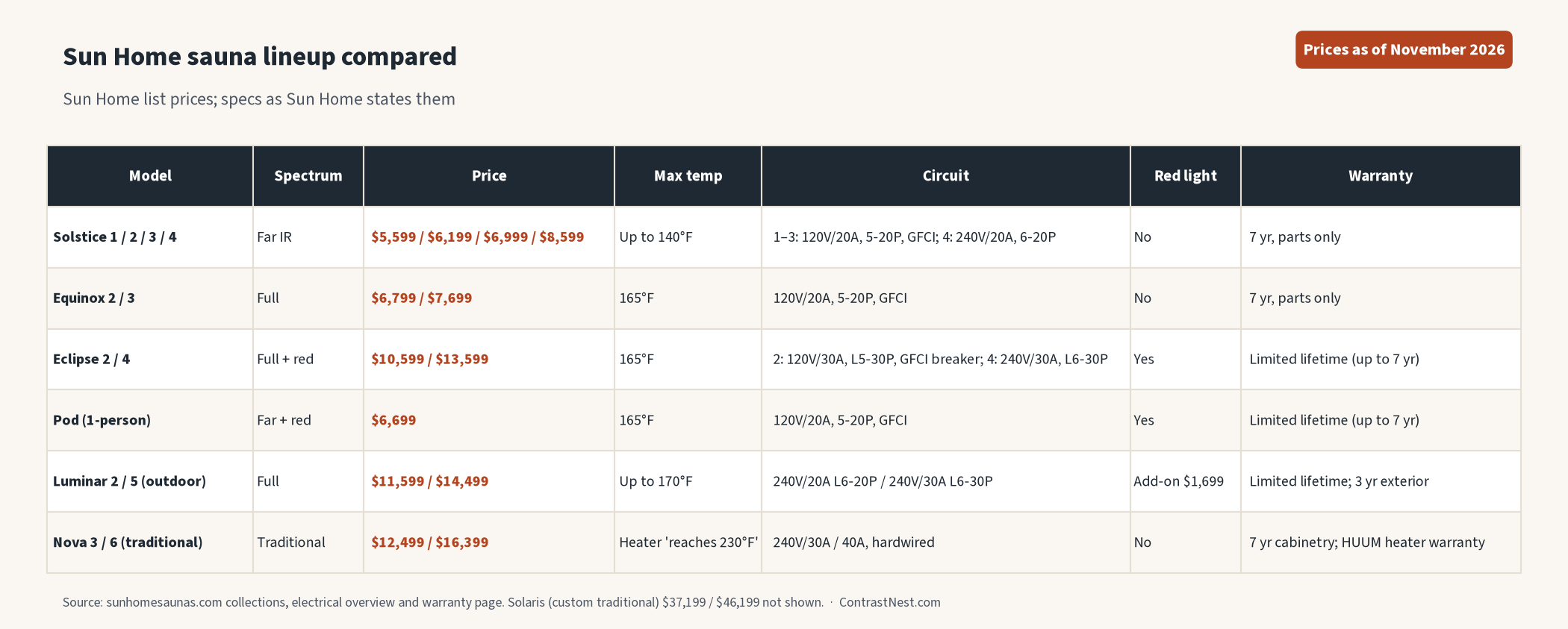
Solstice (far infrared)
The Solstice is Sun Home’s entry line: far infrared only, eucalyptus interior, one to four seats. Sun Home rates it up to 140°F (Sun Home Solstice 2). Sun Home lists the Solstice 2 at 2,006W on a dedicated 120V/20A circuit. The 4-person moves to 240V.
Equinox (full spectrum, 120V)
The Equinox 2 is the model ContrastNest’s buyer’s guide ranks first on documentation and circuit, not on any test of ours. Sun Home rates it to 165°F, at 1,880W on a dedicated 20A GFCI-protected circuit with a NEMA 5-20P plug, and describes it as “pairing full-spectrum heaters with far-infrared panels” (Sun Home Equinox 2). Some third-party coverage lists 170°F; we follow Sun Home’s 165°F. No red light. Is the full-spectrum upgrade worth about $500–$700 over the matching Solstice? See is full spectrum worth it?.
Eclipse (full spectrum + red light)
The Eclipse adds factory-integrated red light panels, which Sun Home lists at 650 nm and 850 nm, and a Japanese cedar interior. Sun Home rates it to 165°F. The 2-person runs on 120V but needs a dedicated 30A circuit with a locking NEMA L5-30P plug and a GFCI breaker, rated at 2,820W, and Sun Home’s comparison says you’ll need an electrician “in most homes.” A retailer guide lists different wood and wavelength figures, and another source calls the Eclipse 2 240V; Sun Home’s own pages say 120V/30A for the 2-person and 240V/30A for the 4-person, and we follow the maker. Sun Home itself says red light therapy is “a separate technology from infrared heat, and research on skin health and recovery is ongoing.”
Pod
The Pod is a round single-seat cabin with red light built in, aimed at small rooms. Sun Home lists it at 120V, 1,710W and 14.2A, on a dedicated 20A GFCI circuit with a NEMA 5-20P plug, and rates it to 165°F with a Japanese cedar interior. A retailer guide calls it plug-and-play “on a standard outlet”; Sun Home’s own page asks for a dedicated 20A circuit. Some sources list hemlock; we follow Sun Home’s Japanese cedar.
Outdoor and traditional: Luminar, Nova, Solaris
- Luminar 2 / 5 (outdoor infrared): $11,599 / $14,499. Full spectrum, rated up to 170°F, aluminum exterior around a red cedar interior. The 2-person needs 240V/20A (NEMA L6-20P), the 5-person 240V/30A (L6-30P); Sun Home says GFCI is required. A red light add-on is sold separately at $1,699. Published third-party reviews from Garage Gym Reviews and WIRED cover the Luminar in depth.
- Nova 3 / 6 (indoor traditional): $12,499 / $16,399. Sun Home says the Nova 3 uses a 6 kW HUUM DROP heater that “reaches 230°F” with a Japanese cedar interior. Nova 3: 240V/30A hardwired; Nova 6: 7.5 kW, 240V/40A hardwired; licensed electrician required.
- Solaris 4 / 6 (outdoor custom traditional): $37,199 / $46,199. Hardwired at 240V/30A (4-person) or 240V/50A (6-person). Sun Home’s return policy excludes made-to-order traditional saunas from returns.
Traditional vs infrared? See infrared vs traditional sauna.
Electrical requirements by model
| Model | Voltage | Circuit | Plug | GFCI (Sun Home) |
|---|---|---|---|---|
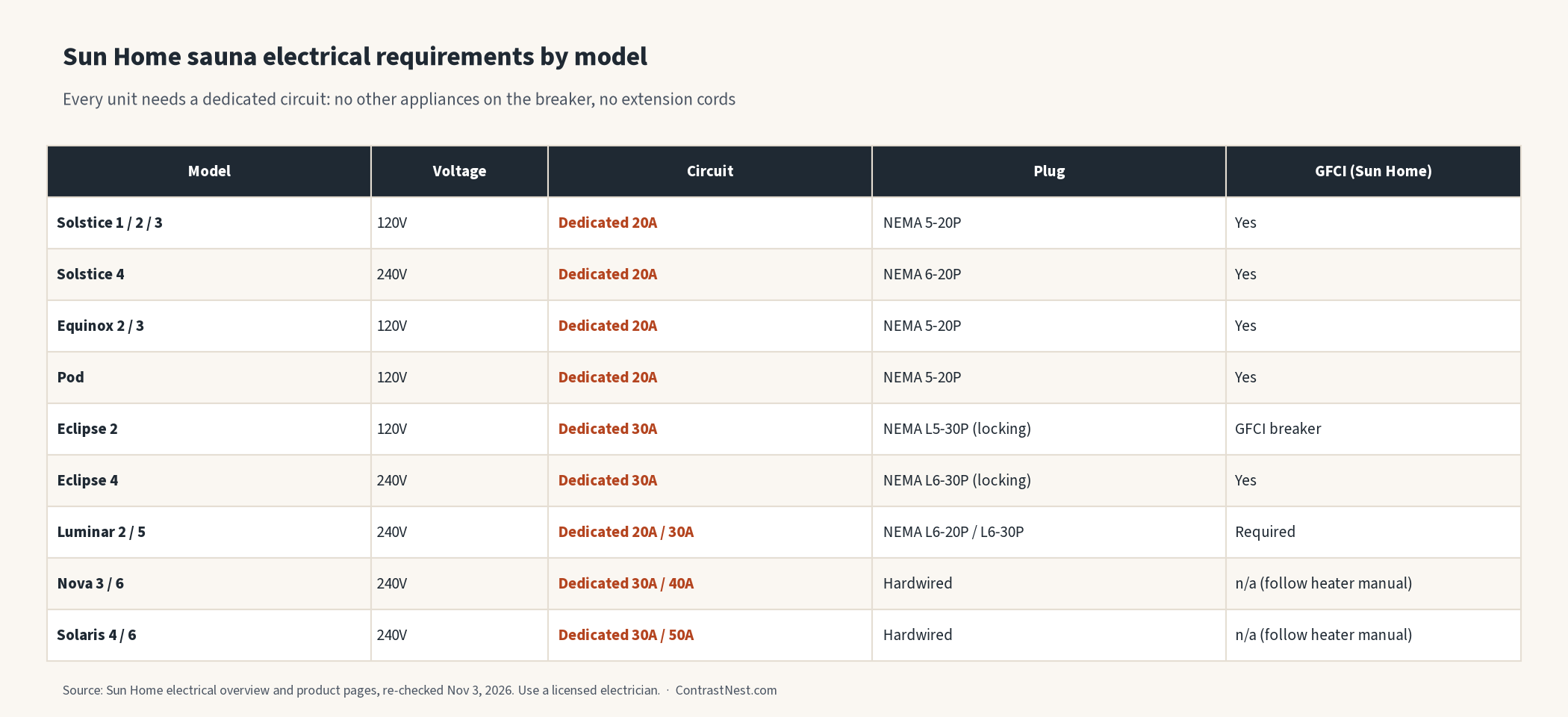
| Solstice 1 / 2 / 3 | 120V | Dedicated 20A | NEMA 5-20P | Yes (“Dedicated 20 Amp GFCI Circuit”) |
| Solstice 4 | 240V | Dedicated 20A | NEMA 6-20P | Yes |
| Equinox 2 / 3 | 120V | Dedicated 20A | NEMA 5-20P | Yes |
| Pod | 120V | Dedicated 20A | NEMA 5-20P | Yes |
| Eclipse 2 | 120V | Dedicated 30A | NEMA L5-30P (locking) | GFCI breaker |
| Eclipse 4 | 240V | Dedicated 30A | NEMA L6-30P (locking) | Yes (“Dedicated 30 Amp GFCI Circuit, NEMA L6-30”) |
| Luminar 2 / 5 | 240V | Dedicated 20A / 30A | NEMA L6-20P / L6-30P | Required |
| Nova 3 / 6 | 240V | Dedicated 30A / 40A | Hardwired | n/a (follow heater manual) |
| Solaris 4 / 6 | 240V | Dedicated 30A / 50A | Hardwired | n/a (follow heater manual) |
Source: Sun Home electrical overview and product pages, re-checked Nov 3, 2026. Sun Home asks for a dedicated circuit for every unit, “no other appliances on that breaker,” and no extension cords, power strips or surge protectors. Hardwired traditional heaters follow their own manual on GFCI. Some heater makers advise against GFCI on hardwired heaters.
No DIY wiring: a licensed electrician should install the circuit under your local code and the manual. Costs and details: does a sauna need 240V? and Home Sauna Cost (2026): Purchase, Installation, 240V Electrical and Running Cost.
Warranty and returns: what “lifetime” actually covers
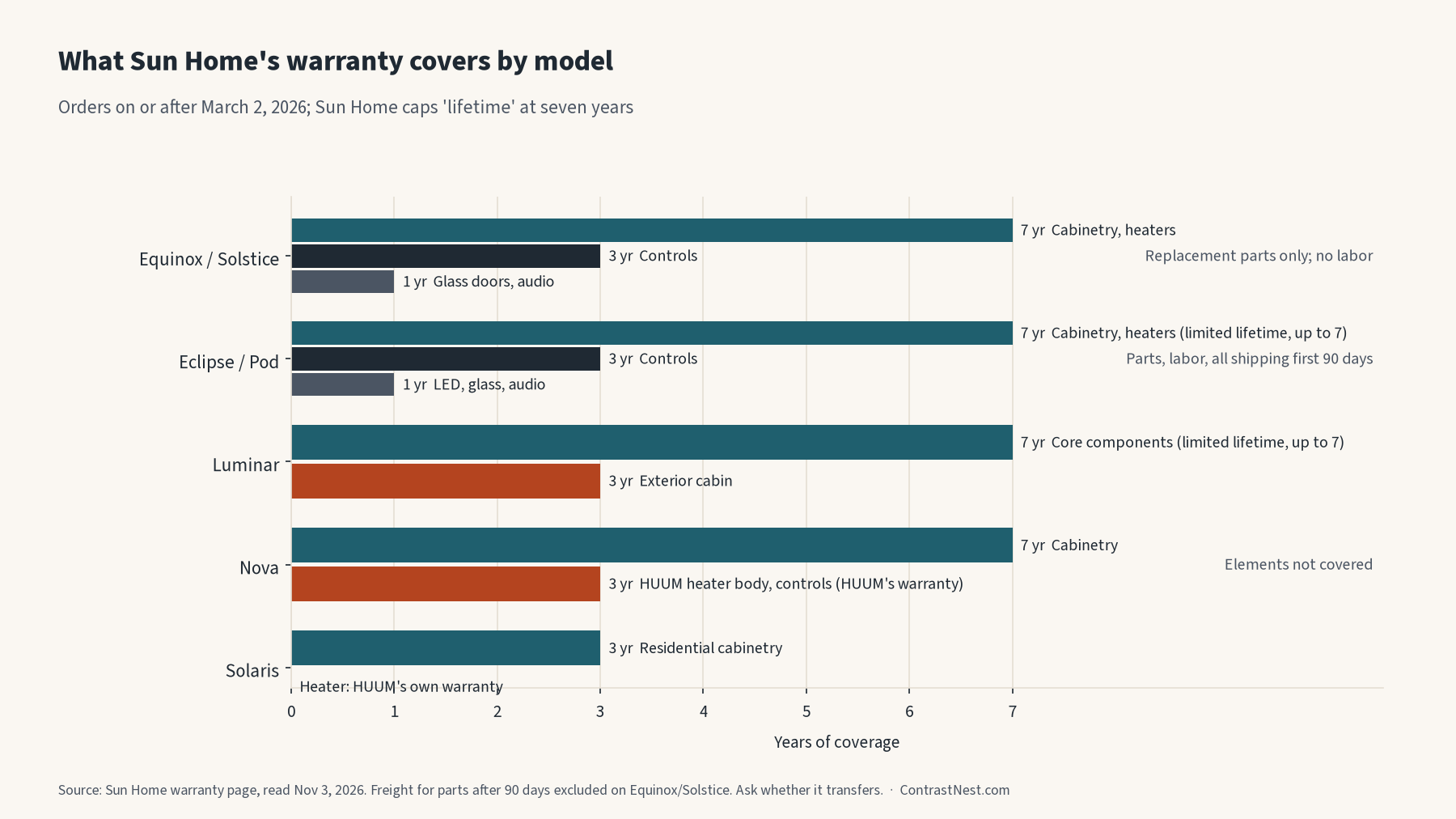
Sun Home’s warranty page (Sun Home warranty, read Nov 3, 2026; terms for orders placed on or after March 2, 2026) splits the lineup:
- Equinox and Solstice: “lifetime” is defined as seven years, and coverage is replacement parts only: 7 years on cabinetry and heaters, 3 years on controls and 1 year on glass doors and audio. Labor isn’t covered, and freight for parts shipped more than 90 days after delivery is excluded.
- Nova: “lifetime” is likewise defined as seven years on the cabinetry. The HUUM Drop heater carries HUUM’s own warranty (3 years on the heater body and controls, residential), and heating elements are consumables that aren’t covered.
- Eclipse and Pod: “limited lifetime” on cabinetry and heaters, 3 years on controls and 1 year on LED lighting, glass and audio. During the first 90 days, Sun Home covers parts, labor and all shipping. The general terms now say limited lifetime coverage on cabinetry and heaters “is applicable for up to seven (7) years, the expected useful lifetime of these components.”
- Luminar: limited lifetime on the core components, with 3 years on the exterior cabin.
- Solaris: 3 years on residential cabinetry; the heater is covered under HUUM’s warranty.
The general terms let Sun Home replace the product or part, or refund the purchase price, “in its sole discretion,” and say freight is otherwise the owner’s responsibility. Because Sun Home now caps “lifetime” at seven years, treat the Eclipse, Pod and Luminar coverage as seven years at most, and ask Sun Home in writing whether the warranty transfers.
Returns and cancellations (Sun Home refund policy): a 3% cancellation fee applies to all cancellations. In-stock orders can be canceled within 24 hours; after an order enters fulfillment, a 25% restocking fee and possibly round-trip shipping apply. Unused saunas in original, unopened packaging may be returned within 30 days, with a 25% restocking fee plus shipping both ways. Sun Home does “not accept returns on uncrated, assembled, or used saunas or cold plunges under any circumstances.” Custom, made-to-order traditional saunas such as the Solaris are non-refundable.
EMF and VOC claims: what is documented, by whom
All figures here come from Sun Home’s testing hub; we did not measure anything (Sun Home safety testing).
- EMF: Sun Home publishes a Vitatech Electromagnetics summary (VTE-3534) reporting magnetic fields of 0.6–4.0 mG at one foot, 0.4–1.8 mG at two feet and 0.3–0.9 mG at three feet across its reported 120V and 230V heater configurations. Sun Home itself says this is brand-level and doesn’t assign one number to every model.
- Air quality (VOCs): Sun Home publishes cabin-air testing of one sauna by VERT Environmental, analyzed by LA Testing under EPA Method TO-15 (April 2026), showing 27 µg/m³ total VOCs. That’s one unit under the tested conditions.
- Listing: Sun Home lists its infrared saunas as ETL Listed through Intertek.
These are manufacturer-commissioned reports, which is more than many brands publish, but they’re not independent random-sample testing of your unit. “Low EMF” alone isn’t a health claim, and we make none. sauna.guide, a research site, also reviews these documents (sauna.guide).
Is Sun Home a good brand? Reputation check
Age and growth
Inc. lists Sun Home at No. 20 on the 2025 Inc. 5000 (No. 198 in 2026) and gives its founding year as 2021 (Inc.).
Ratings
Sun Home’s own site lists its customer-review score; treat it as brand-collected.
Consumer Reports: we found no Consumer Reports rating of Sun Home saunas.
What owners report
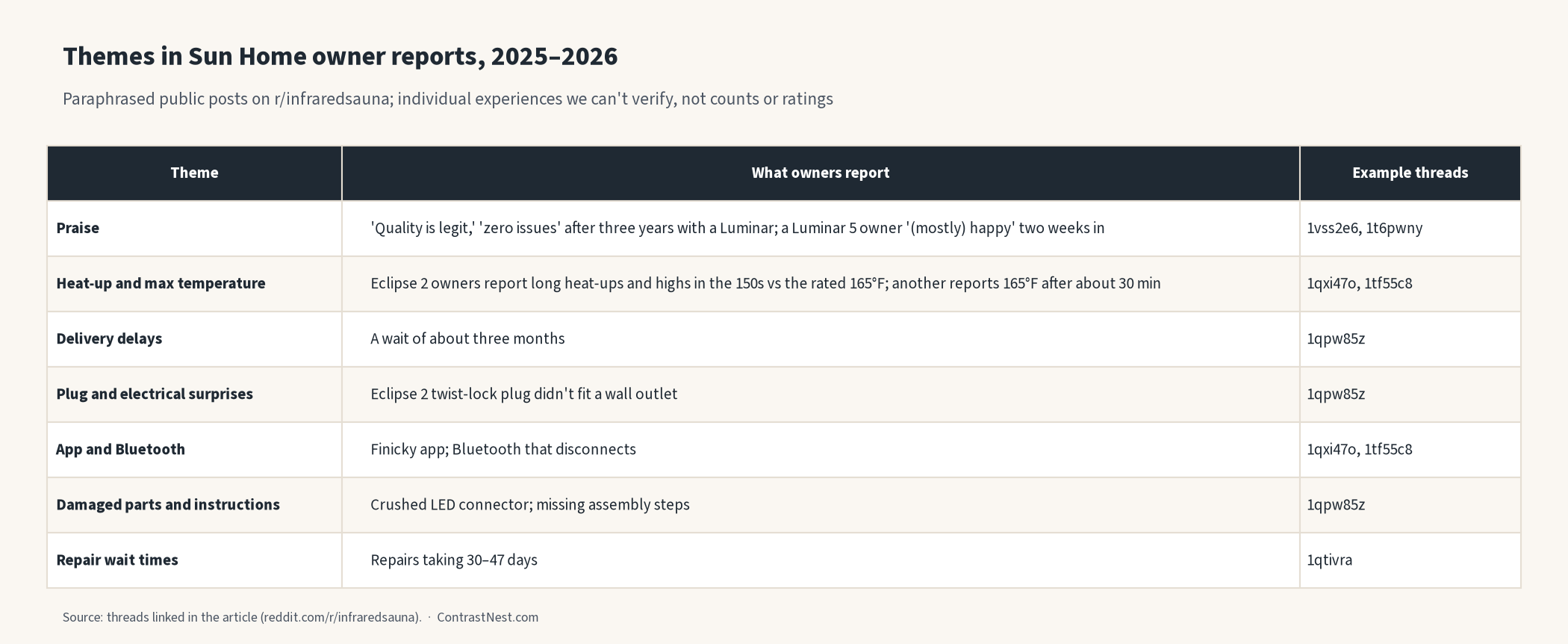
We read public owner posts and review summaries from 2025–2026. They are individual experiences we can’t verify. We paraphrase and link each one.
| Theme | What owners report | Example threads |
|---|---|---|
| Praise | “Quality is legit,” “zero issues” after three years with a Luminar; a Luminar 5 owner “(mostly) happy” two weeks in | 1vss2e6, 1t6pwny |
| Heat-up and max temperature | Eclipse 2 owners report long heat-ups and highs in the 150s vs the rated 165°F; another reports reaching 165°F after about 30 minutes | 1qxi47o, 1tf55c8 |
| Delivery delays | A wait of about three months | 1qpw85z |
| Plug and electrical surprises | Eclipse 2 twist-lock plug didn’t fit a wall outlet | 1qpw85z |
| App and Bluetooth | Finicky app; Bluetooth that disconnects | 1qxi47o, 1tf55c8 |
| Damaged parts and instructions | Crushed LED connector; missing assembly steps | 1qpw85z |
| Repair wait times | Repairs taking 30–47 days | 1qtivra |
Praise
One owner of a Luminar 5 said that, roughly two weeks in, they were “(mostly) happy,” while calling the price “easily 4x more than I had planned to spend” and saying “the warranty is lacking”; at 65°F outside, it reached 125°F inside in about 15 minutes (r/infraredsauna). In another thread, commenters wrote “Quality is legit and it gets plenty hot,” and one reported three years with an outdoor Luminar and “zero issues,” though the same thread also has complaints (r/infraredsauna). In an Eclipse 2 thread, one owner said they use theirs “around 145–155” (r/infraredsauna).
Complaints
One Eclipse 2 owner said “we waited 3 frickin months,” that the “3 prong twist” plug “will not fit into conventional wall plug” despite being assured it would plug into a 110 outlet, and reported “a crushed connector on LED wiring” and that “Many, many steps were omitted” from the instructions (r/infraredsauna). Sun Home’s own pages list the L5-30P and a dedicated 30A circuit, so read the electrical table above. Another Eclipse 2 owner said heat-up “takes over an hour,” the best they get is “in the 150’s” against a 165° maximum, the sauna has shut off, and the “app is very finicky” (r/infraredsauna); another owner in that thread said they had “no problem reaching the 165°F range once fully heated after 30 minutes.” A commenter in a separate thread said the Bluetooth “disconnects all the time” (r/infraredsauna). In a Luminar thread, commenters described waits for repairs: “broken for 47 days” and repairs taking “30–40 days” (r/infraredsauna).
Sun Home’s public responses
A “SunHomeSupport” account replies in several threads. It apologized to the owner who waited three months and asked owners to DM order details. In the Luminar 5 thread, it said a cover-related warranty note was “inadvertently packed in” and that using the sauna without a cover “will not void your warranty.”
Sun Home vs Sunlighten vs Clearlight vs Dynamic
| Model | Price (as of November 2026) | Spectrum | Circuit | Max temp | Warranty |
|---|---|---|---|---|---|
| Sun Home Equinox 2 | $6,799 | Full | 120V / 20A dedicated, 5-20P, GFCI | 165°F | 7 yr, parts only |
| Sun Home Eclipse 2 | $10,599 | Full + red | 120V / 30A, L5-30P, GFCI breaker | 165°F | Limited lifetime (up to 7 yr) |
| Sunlighten Amplify II | $5,999 | Full | 120V / 20A dedicated, 5-20 | 170°F (ideal conditions) | 7 yr cabinetry/heaters, 3 yr controls |
| Clearlight Sanctuary 2 | $7,299–$7,699 (Black Friday pricing through Nov 30) | Full | 120V / 20A, 5-20P | Not published by maker | Limited lifetime residential |
| Dynamic Barcelona | $1,800–$2,100 | Far (carbon) | 120V / 15A, dedicated recommended | 140°F | 5 yr heaters/electronics, 1 yr wood |
Sources and full comparisons: Best Infrared Saunas for Home (2026): A Research-Based Buyer’s Guide. For two-seaters only, see best 2-person infrared saunas.
Which Sun Home model to choose
- Lowest cost, gentler heat: Solstice 1–3 on a dedicated 120V/20A circuit.
- Most heat on 120V/20A: Equinox 2, rated 165°F.
- Red light built in, small space: Pod.
- Red light, two people: Eclipse 2, but budget for a 30A twist-lock circuit.
- Outdoors: Luminar 2 or 5 on 240V.
- Traditional steam and stones: Nova indoors; Solaris for a custom outdoor build.
Pairing with cold? Sun Home also sells cold plunges from $3,899 (as of November 2026).
Health note: Talk to your doctor before using a sauna or cold plunge, especially if you are pregnant or have a heart condition, low or high blood pressure, or another health condition. See our Health Disclaimer.
Health and safety: We make no medical claims about any model. A large Finnish cohort found frequent traditional sauna use was associated with lower cardiovascular mortality in middle-aged men (PubMed 25705824); that’s an association, not proof any infrared cabin causes a benefit. A small 2025 study found core temperature rose about 0.4°C in a traditional sauna and stayed roughly unchanged in far infrared under its conditions (PubMed 40332494). Mayo Clinic says to talk with your doctor before using an infrared sauna if you have health concerns (Mayo Clinic). Harvard Health suggests no more than 15–20 minutes and drinking two to four glasses of water afterward (Harvard Health). Poison Control says pregnant women and children are generally advised to avoid saunas, and to avoid alcohol and medication patches (Poison Control). Talk to a doctor first if you are pregnant or have a heart condition, low blood pressure, a recent illness, or take medication.
FAQs
Are Sun Home saunas worth it?
For some buyers. Sun Home publishes detailed circuit, warranty and lab-summary documents, and many owners report being happy. But prices are upper-middle, labor coverage on most models is limited, returns are strict, and owners report delivery and support delays. Compare models in Best Infrared Saunas for Home (2026): A Research-Based Buyer’s Guide.
Is Sun Home a good brand?
Sun Home says it was founded in 2021. Owner reports are mixed: praise for the Luminar, and complaints about delays, setup and support on some Eclipse and Luminar orders.
Who manufactures Sun Home saunas?
Sun Home says its saunas are designed and engineered in California, with components sourced globally and assembled in Asia. It doesn’t publish a named factory per model.
How much does a Sun Home sauna cost?
Prices as of November 2026: $5,599–$8,599 for the Solstice, $6,799–$7,699 for the Equinox, $6,699 for the Pod, $10,599–$13,599 for the Eclipse, $11,599–$14,499 for the Luminar, $12,499–$16,399 for the Nova and $37,199–$46,199 for the Solaris, before electrical work.
Which home sauna is best for most people?
There’s no single independent ranking, and the best fit depends on your circuit, space, budget and whether you want traditional or infrared heat. For our research-based picks by category, see Best Infrared Saunas for Home (2026): A Research-Based Buyer’s Guide.
Is the Sun Home Equinox the same as a Sunlighten sauna?
We couldn’t confirm that from a verifiable public source, so we don’t claim it. On published specs, the Equinox 2 (1,880W, 20A, 165°F) and Sunlighten Amplify II (1,880W, 20A, 170°F ideal conditions) are close, but warranties and support differ; compare them directly.
Does the Equinox plug into a normal outlet?
It plugs in at 120V, but Sun Home requires a dedicated 20A GFCI-protected circuit with a NEMA 5-20 outlet, not a shared household outlet or an extension cord. Many homes need an electrician to add one.
The bottom line
Sun Home’s strengths are documentation and range: clear circuit specs, a published warranty and commissioned test summaries. The trade-offs are price, limited labor coverage, a strict return policy and mixed owner reports on delivery and support. Read the electrical table and warranty terms for your exact model, and get lead time and “lifetime” coverage in writing before you pay.
Disclaimer: Educational information, not medical advice. Talk to your doctor before using a sauna, especially if you are pregnant, have a heart or blood-pressure condition, or take medication. Have a licensed electrician do all wiring. ContrastNest.com has not tested any Sun Home product.