
ContrastNest is reader-supported. When you buy through links on this page we may earn a commission, at no extra cost to you. Our guides are research-based and AI-assisted, and checked against sources; we don’t claim hands-on testing. Affiliate Disclosure →
How we researched this. This comparison is research-based. We compiled it from manufacturer and dealer pages, one published owner temperature log, sauna-builder explainers and owner forums, all checked on November 1, 2026, with prices and links re-checked on November 3, 2026. We have not tested, used, measured or owned any sauna mentioned here. Every temperature figure comes from the source we name.
Quick verdict by climate and use
| If you… | Lean toward | Why |
|---|---|---|
| Want the lowest price for an outdoor traditional sauna | Barrel (at most brands) | Entry barrels start around $3,500–$5,300 with a heater included |
| Live where winters are long and cold | Cabin | Builders report insulated walls hold heat better than single-layer staves |
| Want even heat and warm feet | Cabin with a high upper bench | Barrels put your feet near the floor, where measured temperatures are much lower |
| Want a classic look and quick setup | Barrel | Simple kit, small footprint |
| Plan to bathe with 4+ people often | Cabin | Flat walls and tiered benches use space better |
Neither shape is healthier. Heat, time and safe use matter more than geometry. For traditional vs infrared heat, see Infrared vs Traditional Sauna: Heat, Cost, Health Evidence and Which to Buy.
How shape affects heat (stratification, bench height, cold feet)
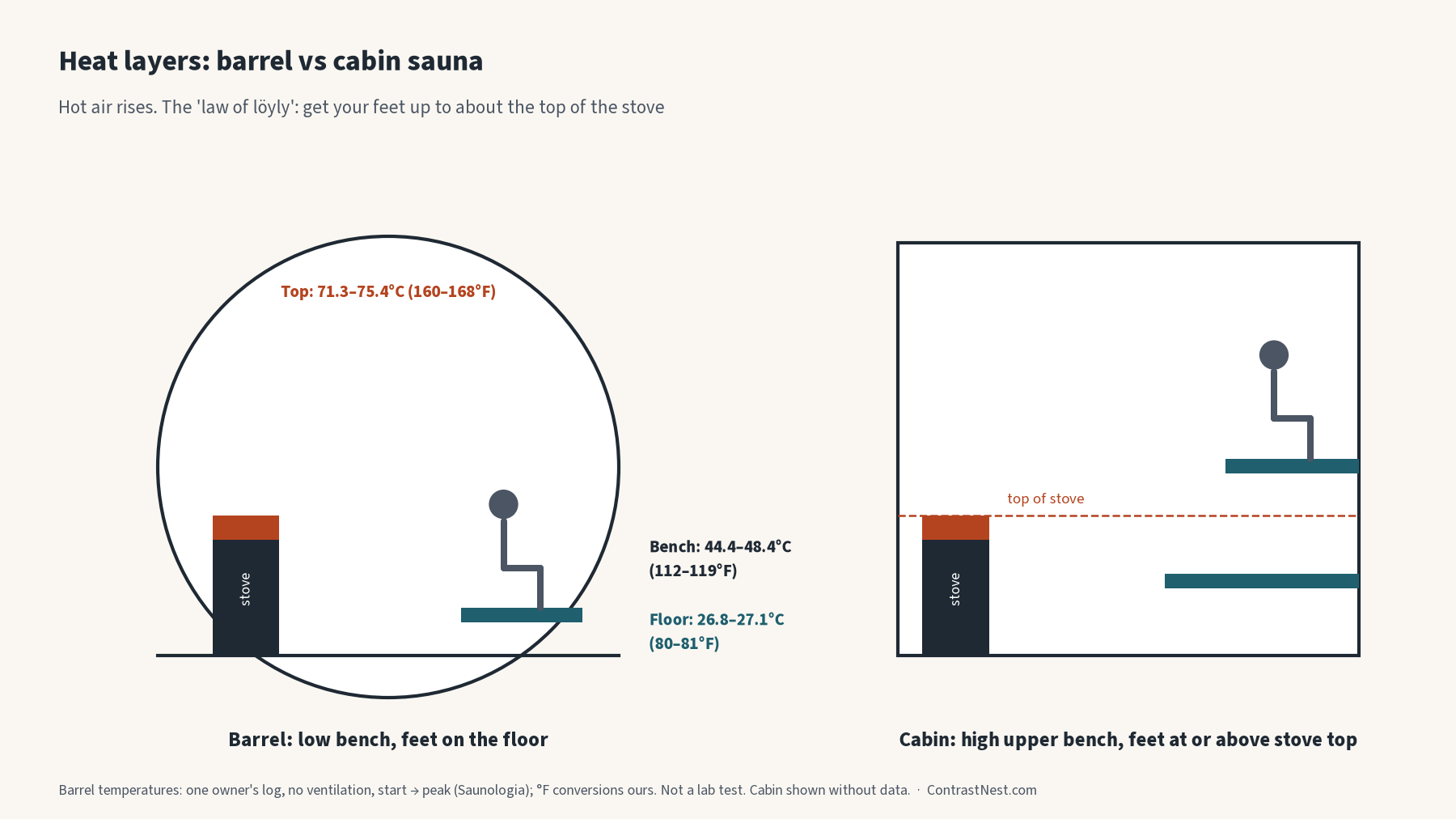
Hot air rises, so every sauna is hotter at the ceiling than at the floor. Finnish sauna practice tries to get your whole body into the hot zone by putting the upper bench high, so your feet sit roughly at or above the top of the stove. Saunologia, a Finnish sauna publication, calls this the “law of löyly” (Saunologia).
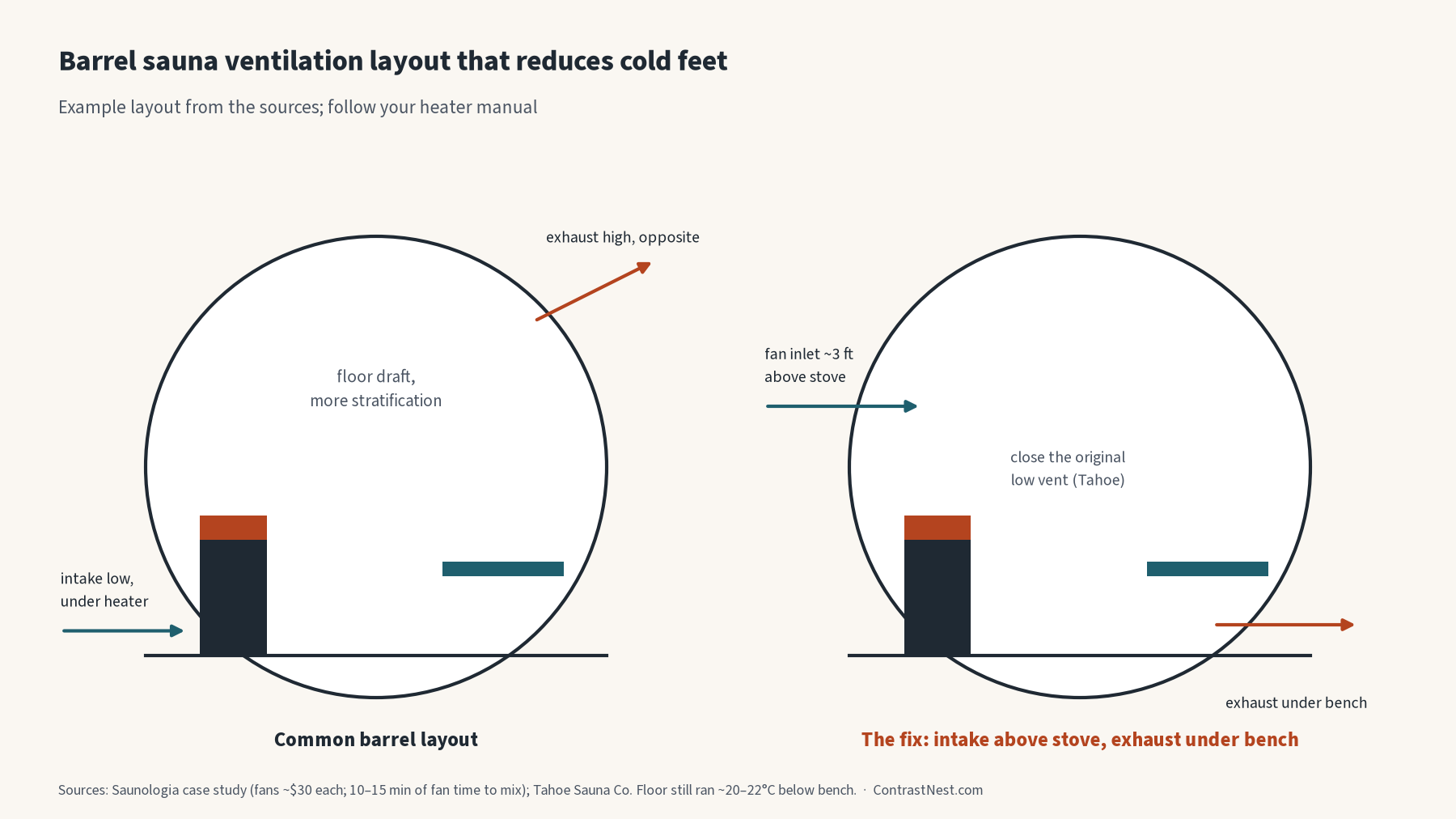
In most barrels, benches sit low and your feet rest on the floor. Many barrels also bring in fresh air at floor level under the heater and exhaust it high on the opposite wall. Saunologia says this “creates draft on the floor, further increases heat stratification, and results in energy loss.”
What one owner measured. Saunologia’s author logged temperatures in his own barrel, writing in the first person on that site, so it isn’t an independent test:
| Condition | Top | Bench level | Floor |
|---|---|---|---|
| No ventilation, start of session | 71.3°C (160°F) | 44.4°C (112°F) | 26.8°C (80°F) |
| No ventilation, peak | 75.4°C (168°F) | 48.4°C (119°F) | 27.1°C (81°F) |
Source: Saunologia case study; Fahrenheit conversions are ours. This is one owner’s barrel, not a lab test, but it’s the only published multi-height log we found.
Two other sources give similar ranges:
- Trumpkin, a sauna researcher, says bathers should see a head-to-toe difference of no more than 36°F, while barrels “range from 60-120°f” (Trumpkin’s Notes).
- Tahoe Sauna Company, a sauna designer-builder, calls cold feet “the most common complaint” from barrel owners and says barrels have one of the biggest head-to-feet gaps of any shape (Tahoe Sauna Co.).
A low-benched cabin stratifies too; a cabin’s advantage is room to raise the upper bench.
How to fix cold feet in a barrel
From the sources above:
- Fix the airflow. Saunologia added a fan-driven inlet about 3 feet above the stove and an exhaust under the bench, using fans that cost about $30 each. The top-to-bench gap shrank, though it took 10–15 minutes of fan time to mix the air. Tahoe Sauna Co. recommends the same layout: intake above the heater, exhaust low on the opposite end. It also suggests closing off the original low vent under the heater.
- Get your feet off the floor. Even with ventilation, the floor stayed about 20–22°C (36–40°F) below bench level, so the author keeps his feet on the opposite bench. Tahoe suggests a raised duckboard or footrest, sitting with your feet up, or lying down.
- Preheat longer, so the benches and floor warm up, not just the air (Tahoe).
- Don’t count on a bigger heater. Tahoe says a bigger heater mainly heats the ceiling, not the floor. Size the heater to the room and climate instead (see heat-up below).
Insulation and cold-climate performance
A typical barrel wall is a single layer of solid wood staves. Redwood Outdoors lists 1½-inch heat-treated hemlock for both its barrel and its cabin (Redwood barrel; Redwood cabin). Almost Heaven lists 1⅜-inch lumber on its Salem barrel (Almost Heaven Salem). A site-built or premium cabin can add a wall cavity with insulation and a vapor barrier.
ThermalFinn, a sauna information site, estimates barrel walls at about R-1.5–2.0 versus R-13+ for an insulated cabin wall, and R-5–8 for a barrel with an insulation wrap. It recommends cabins where temperatures regularly fall below -15°C (5°F) and in heavy snow (ThermalFinn). ThermalFinn doesn’t show how those R-values were derived, so treat them as estimates. Many prefab “cabins,” including Redwood’s, use the same solid-wood wall as their barrels rather than an insulated cavity, so check the spec sheet.
Snow and cold: ThermalFinn notes snow slides off a curve more easily than off a flat roof, but heavy wet snow can still sit on top and should be brushed off. A sauna dealer reports seeing a 6 kW barrel that wouldn’t pass about 150°F in mid-20s°F weather until the heater was upsized (Sauna Marketplace).
Our read: in a cold climate, an insulated cabin with a properly sized heater is the safer bet. In mild climates, either works.
Heat-up time and heater sizing
Heat-up claims vary a lot:
- ThermalFinn says a 6 kW heater brings a barrel to 85°C (185°F) in 25–35 minutes, versus 40–55 minutes for a cabin of the same footprint. It attributes the difference to the barrel’s smaller air volume. No measurement data is shown.
- In our infrared vs traditional sauna guide and our home sauna cost guide, we cited 20–35 minutes (Saunafin) and 30–45 minutes (Sun Valley Saunas) for traditional saunas generally. Estimates vary by source: about 20–45 minutes.
Size the heater to the room. Harvia’s US KIP manual lists 4.5 kW for 100–210 cu ft, 6 kW for 170–300 cu ft and 8 kW for 250–425 cu ft, assuming an insulated, paneled room (Harvia KIP manual). Redwood’s 6-person barrel is listed at 140 cu ft inside and its 4-person cabin at 169.6 cu ft. Running cost: at the U.S. average 18.16¢/kWh (EIA, August 2026), a 6 kW heater running a full hour costs up to about $1.09 a session, or about $14.16 a month at 13 sessions. An 8 kW heater costs up to about $1.45 a session, and the 9 kW heaters on Backyard Discovery’s saunas up to about $1.63. Heaters cycle once hot, so these are upper bounds. For the full math, see Home Sauna Cost (2026): Purchase, Installation, 240V Electrical and Running Cost.
More on outdoor sauna electrical requirements.
Cost comparison (same-brand price pairs)
Prices are approximate, as of November 2026.
Redwood Outdoors barrel vs cabin
| Model | Price (sale, as of November 2026) | People | Interior volume | Wood | Weight |
|---|---|---|---|---|---|
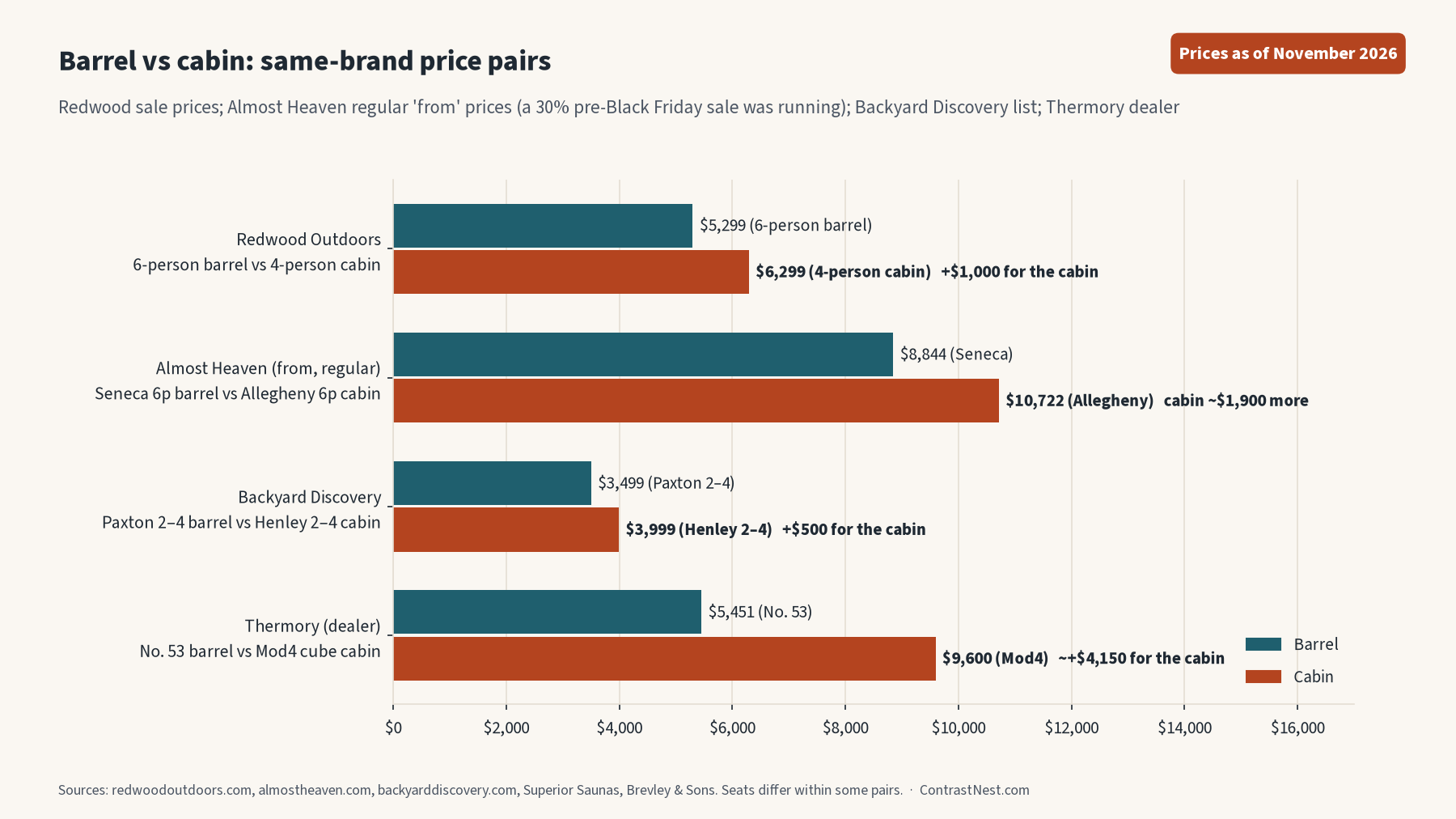
| 6-person barrel | $5,299 ($6,299 list) | Up to 6 (“spacious for 4”) | 140 cu ft | 1½” heat-treated Canadian hemlock | 900 lb |
| 4-person cabin | $6,299 ($7,299 list) | 4 (“spacious for 3”) | 169.6 cu ft | 1½” heat-treated Canadian hemlock | 1,150 lb |
Sources: barrel, cabin. Redwood lists a 1-year limited warranty on its saunas, and Harvia heaters at 1 year on elements and 5 years on other parts. The barrel listing includes a 6 kW Harvia KIP heater, and both the barrel and the cabin showed as available as of November 2026; confirm the cabin’s heater package at checkout. Redwood’s own price premium is $1,000 for the cabin, which also seats fewer people.
Almost Heaven
| Model | Shape | Heater (base option) | Price |
|---|---|---|---|
| Salem | 2-person barrel | 6 kW Harvia KIP | from $4,485 |
| Seneca | 6-person barrel | 8 kW Harvia KIP | from $8,844 |
| Princeton | 6-person barrel | 8 kW Harvia KIP | from $8,932 |
| Lewisburg | 6–8 person barrel | 8 kW Harvia KIP | from $9,083 |
| Kuuma | barrel | 8 kW Harvia KIP | from $14,132 |
| Takoa | 4–6 person barrel | 8 kW Harvia KIP | from $15,273 |
| Magnus | 6-person barrel | 8 kW Harvia KIP | from $16,558 |
| Allegheny | 6-person cabin | 8 kW Harvia KIP | from $10,722 |
| Appalachia | 6-person cabin | 8 kW Harvia KIP | from $12,650 |
Source: almostheaven.com product listings, regular “from” prices as of November 2026. When we checked, Almost Heaven was running a pre-Black Friday sale of 30% off most of these models (the Salem was not discounted), so the price at checkout may be lower; sale prices change often. Like for like, barrels are cheaper here: the Seneca 6-person barrel is about $1,900 less than the Allegheny 6-person cabin, both with an 8 kW KIP. Almost Heaven’s premium barrels (Kuuma, Takoa, Magnus) cost more than its cabins.
Backyard Discovery
| Model | Shape | Heater | Price |
|---|---|---|---|
| Paxton 2–4 | barrel | 9 kW PrairieFire | $3,499 |
| Paxton 4–6 | barrel | 9 kW | $4,499 |
| Lennon 2–4 | cube | 9 kW | $3,499 |
| Lennon 4–6 | cube | 9 kW | $4,499 |
| Henley 2–4 | cabin | 9 kW | $3,999 |
Sources: Backyard Discovery traditional saunas, Paxton, Lennon; Henley. Backyard Discovery prices barrel and cube identically. The brand lists a 5-year warranty on all components, ETL certification, and says a professional electrician is required.
Thermory (dealer prices)
A Thermory 4-person No. 53 barrel kit is $5,451 at a dealer as of November 2026 (Superior Saunas). The Mod4 Traditional, a modular cube cabin, is $9,600 (Brevley & Sons listing), a premium of roughly $4,150. Both use thermally modified wood. Thermory gives its saunas a 2-year limited warranty that excludes heaters, lights, electrical parts and glass (Thermory FAQ; warranty terms).
Durability: wood movement, bands, leaks, roofing
Barrels are held together by steel bands around the staves. Wood swells and shrinks with moisture and heat, so bands need periodic adjustment. ThermalFinn lists band retightening one to two times a year.
- Leaks: Trumpkin says water hitting the upper half of a barrel runs along the curve and into the stave joints, while rain on a cabin’s vertical wall runs off the outside. Covers are sold for this: Almost Heaven’s barrel rain jacket is $337, and Backyard Discovery includes a steel roof.
- Warping and rot: Trumpkin warns that warped staves leave gaps tightening can’t close. He also says moving a used barrel rarely works once the bands are loosened, and that “cedar does indeed rot, despite marketing claims.” He suggests many barrels don’t last more than about five years. ThermalFinn estimates 10–20 years for cedar staves and 15–25 for thermowood with maintenance. These lifespans come from opinion and experience, not published data.
- Cabins shed water like a small building and can be re-roofed and refinished, but they’re heavier (Redwood’s 4-person cabin is 1,150 lb vs 900 lb for the 6-person barrel) and usually take longer to assemble.
Foundation, placement and permits
Both shapes need a level, well-drained base. Almost Heaven recommends concrete, pavers, decking or stone. Barrels sit on cradles; Backyard Discovery includes HDPE cradles with cement and ground anchors. Weight guides the base: 900–1,150 lb for the Redwood pair, and about 1,100 lb for Almost Heaven’s Costco-sold Ripley barrel.
Electric traditional heaters need 240V. Costco lists the 8 kW Ripley at 240V/40A (Costco, checked Nov 3, 2026), and 6 kW models typically list 30A. Use a licensed electrician. Permits vary by city. Our home sauna cost guide covers permit examples, foundation options and electrician costs: Home Sauna Cost (2026): Purchase, Installation, 240V Electrical and Running Cost.
More on outdoor sauna setup.
Cube and pod alternatives
“Cube” saunas, such as Backyard Discovery’s Lennon or Almost Heaven’s Blackwater, are compact cabins. They have flat walls like a cabin, often with stacked two-tier benches. Backyard Discovery says the Lennon 4–6 uses a “stacked two-tier layout, so you can choose your heat intensity,” which addresses the barrel’s low-bench problem. Prices ranged from $3,499 (Lennon 2–4) to $8,397 (Almost Heaven Blackwater mini cube, 6 kW). Thermory also sells barrel-adjacent “Sauna Squares.”
What owners say
Paraphrased from r/Sauna; individual opinions, not verified by us:
- In the top-ranking comparison thread, the original poster relayed a rival sauna company’s claim that barrel floors run cooler. A commenter said that with a properly rated heater barrels get just as hot, and that the main loss is having no high and low benches (thread).
- A 2021 owner said barrels leak in the rain and a simple tarp stops it (thread).
- In a “barrel sauna hate?” thread, commenters described hot heads and cold feet, and suggested many barrels go unused or rot within a few years. Others defended barrels as better than no sauna (thread).
Safety note
Health note: Talk to your doctor before using a sauna or cold plunge, especially if you are pregnant or have a heart condition, low or high blood pressure, or another health condition. See our Health Disclaimer.
Traditional saunas run hotter than infrared. Northwestern Medicine cites roughly 150–195°F. Drink water, keep sessions short at first, and leave if you feel dizzy or unwell. Talk to a doctor first if you’re pregnant, have heart disease or low or high blood pressure, or take medication. Poison Control says children and pregnant women are generally advised to avoid saunas, and that people using medication patches should avoid them. Don’t drink alcohol before or during use (Northwestern Medicine; Harvard Health). If you follow the sauna with a cold plunge or snow roll, sudden cold raises heart rate and blood pressure, so get medical advice first if you have a heart or blood-pressure condition.
FAQs
Are barrel saunas better than regular saunas?
Not in general. Barrels can be cheaper and quick to set up. Cabins usually allow higher benches (warmer feet) and, when insulated, hold heat better in cold weather. Like for like they’re usually cheaper (Almost Heaven’s Seneca barrel is about $1,900 less than its Allegheny cabin), though premium barrels can cost more than cabins.
Why not get a barrel sauna?
The main reasons are cold feet from low benches (one owner’s log showed the floor about 20–22°C (36–40°F) below bench level), limited bench tiers, leaks without a cover, band maintenance, and weaker cold-weather performance than an insulated cabin. Many owners are happy with theirs, especially with a fan and a raised footrest.
Which type of sauna is healthiest?
No sauna shape has been shown to be healthier. Research on traditional sauna use, such as the Finnish cohort linking frequent use with lower cardiovascular mortality in men (PubMed 25705824), shows associations, not proof, and didn’t compare shapes. Mayo Clinic says larger studies are still needed on claimed infrared benefits (Mayo Clinic).
What is the 200 rule for saunas?
It’s a comfort rule of thumb: temperature in °F plus relative humidity in % adds up to about 200 (for example, 180°F at 20%). It’s not a Finnish standard, a medical guideline or a safety limit (Crateworks; Home Sauna Guide). It’s meant for traditional saunas with steam, not infrared. More in What Is the 200 Rule for Saunas? Temperature + Humidity Explained.
Is the Costco barrel sauna good?
Costco sells Almost Heaven barrels made for it. The 4–6 person Ripley lists an 8 kW Harvia heater, 240V/40A, 1,100 lb and $5,999.99 online as of November 2026 (Costco, checked Nov 3, 2026). Topture, a sauna retailer that sells competing models, said in a comparison updated Oct 29, 2026 that it showed the 2-person Arcadia at $3,499.99 (Topture); Costco’s own Arcadia listing wasn’t available to us. The Harvia heaters are a plus. The barrel trade-offs above still apply, and you’ll need a 240V circuit, a base and usually a cover.
Do barrel saunas leak?
They can. Owners and builders report water entering through stave joints on the upper curve. A fitted cover or roof is the common fix: Almost Heaven sells a $337 rain jacket, and Backyard Discovery includes a steel roof. Keep the bands adjusted.
The bottom line
Choose a barrel for price, looks and a fast, simple install in a mild climate, and plan on a fan, a footrest and a cover. Choose a cabin for colder climates, warmer feet, tiered benches and larger groups. Then budget the electrical work and base using Home Sauna Cost (2026): Purchase, Installation, 240V Electrical and Running Cost.
Disclaimer: Educational information, not medical advice. Talk to your doctor before using a sauna, especially if you are pregnant, have a heart or blood-pressure condition, or take medication. ContrastNest.com has not tested these products. Prices and specs change; confirm them with the seller.